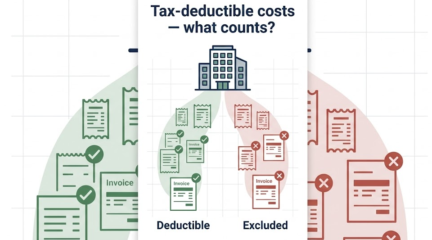

Advertising expenses are fully deductible for tax purposes — with no monetary limit. Entertainment expenses are not tax-deductible and will not reduce your CIT or PIT. The line between them is drawn by the purpose of the expense: advertising promotes a product or service to a broad audience, while entertainment builds the company’s image with specific business partners. Below you will find the specific rules, current case law and practical bookkeeping guidance.
What is entertainment under Polish tax law?
Entertainment (reprezentacja) is any action whose sole or dominant purpose is to create and reinforce a positive image of the taxpayer in the eyes of other entities. This was established by the Supreme Administrative Court in its landmark resolution of 17 June 2013, issued by a panel of seven judges (case no. II FSK 702/11).
Entertainment expenses are excluded from deductible costs under Article 16(1)(28) of the CIT Act (consolidated text: Journal of Laws 2025, item 278) and Article 23(1)(23) of the PIT Act (consolidated text: Journal of Laws 2025, item 163). The provision explicitly mentions “in particular” expenses on catering services, food and beverages, including alcohol.
How has the definition of entertainment evolved?
Before 2013, tax authorities equated entertainment exclusively with lavishness and ostentation. The Supreme Administrative Court ruling (II FSK 702/11) broke with this approach. The court held that lavishness, ostentation and extravagance are irrelevant. Only the purpose of the expense matters — whether it serves to create a positive image of the company. This line of case law is now firmly established and dominant.
From our experience at Progress Holding, this change paradoxically made life harder for business owners. Previously, it was enough to check whether an expense was “lavish”. Now you must analyse the purpose of every business meeting — and that requires careful documentation.
What is advertising and why is it tax-deductible?
Advertising is the dissemination of information about a company, its products or services in order to reach potential customers and encourage them to buy. Advertising expenses are deductible under the general rules of Article 15(1) of the CIT Act — with no monetary limit whatsoever.
Advertising differs from entertainment in three ways. First, it is aimed at a broad, unspecified audience. Second, its purpose is to promote a product or service, not to build a relationship with a specific contractor. Third, it is informational and persuasive — it encourages a purchase.
Typical advertising expenses that are tax-deductible
- Google Ads, Meta Ads, LinkedIn Ads and other forms of online advertising
- Promotional materials: leaflets, banners, roll-ups, posters
- Branded merchandise of low unit value (pens, notebooks, mugs, lanyards)
- Website and SEO
- Press, radio and television advertising
- Trade fair and conference participation (exhibition stand, promotional materials)
- Production of advertising spots and video content
- Sponsorship — provided the company receives equivalent advertising benefits in return
An individual tax ruling issued by the Director of National Tax Information on 16 May 2025 (ref. 0114-KDIP2-1.4010.148.2025.4.PK) confirmed that expenses on promotional materials and organising industry events can be deductible costs, as long as they have a causal link to revenue generation.
Where is the line between entertainment and advertising?
The line is drawn by the purpose of the expense and the audience. If the expense promotes a product to a broad audience, it is advertising. If it builds the company’s image with specific business partners, it is entertainment.
| Criterion | Advertising (deductible) | Entertainment (NOT deductible) |
|---|---|---|
| Purpose | Product/service promotion, encouraging purchases | Creating a positive company image, building relationships |
| Audience | Broad, unspecified group of potential customers | Specific contractors, business partners |
| Character | Informational, persuasive | Relational, image-building |
| Exclusion basis | None — advertising is 100% deductible | Article 16(1)(28) of the CIT Act |
| VAT deduction | YES — full input VAT deduction | YES — except catering and accommodation services |
| Examples | Google Ads, leaflets, branded merchandise, trade fairs, TV spots | Dinner with a contractor, expensive gifts, alcohol for clients |
In our clients’ practice, the most common classification problems arise with three categories: business meals at restaurants, gifts for contractors and company events with external guests. Each case requires an individual analysis of the circumstances.
How to classify specific expenses — 10 practical examples
The table below shows the most common marketing expenses and their tax classification based on current administrative court rulings and individual interpretations by the Director of National Tax Information.
| Expense | Classification | Rationale |
|---|---|---|
| Lunch with a contractor at a restaurant (standard menu) | Depends on purpose | If the purpose is to discuss cooperation terms — deductible. If the purpose is relationship/image building — entertainment (not deductible) |
| Exclusive dinner with expensive wines | Entertainment (not deductible) | Dominant purpose: creating an image of affluence and professionalism |
| Pens, mugs with company logo (value up to PLN 20/item) | Advertising (deductible) | Company logo + low value = promotional item, not a gift |
| Elegant watch for a client (no logo, PLN 500) | Entertainment (not deductible) | No logo + high value = relationship building, not advertising |
| Alcohol given to contractors (even with logo) | Entertainment (not deductible) | Alcohol is always entertainment — no exceptions (the only exception: alcohol of your own production with company logo) |
| Coffee and tea for visitors at the office | General overhead (deductible) | Office running cost, not entertainment |
| Facebook advertising campaign | Advertising (deductible) | Promotion aimed at a broad audience |
| Sports team sponsorship with logo on jerseys | Advertising (deductible) | Equivalent advertising benefit received in exchange for funds provided |
| Company anniversary party with contractors attending | Entertainment (not deductible) — for the portion relating to external guests | Image building towards external entities (ruling of the Regional Administrative Court in Łódź, I SA/Łd 649/13) |
| Catering at an industry conference organised by the company | Advertising (deductible) | Element of a promotional event — refreshments for participants, not entertainment |
We have conducted hundreds of these analyses at Progress Holding and know that documentation is key. For every restaurant meeting, note: who attended, what was the purpose and what was agreed. A note on the back of the invoice is your protection in case of an audit.
How does VAT deduction work for advertising and entertainment?
Full input VAT deduction applies to advertising expenses under the general rules. Entertainment expenses are also eligible for VAT deduction, with two important exceptions under Article 88(1)(4) of the VAT Act (consolidated text: Journal of Laws 2024, item 361).
Two exceptions — no VAT deduction
- Catering services (on-premises dining) — meals prepared and served at the place of preparation (e.g. in a restaurant). No right to deduct input VAT, regardless of whether the expense is advertising or entertainment.
- Accommodation services — except when acquired for resale (re-invoicing) under Article 8(2a) of the VAT Act.
Catering services vs delivered catering — an important distinction
A delivered catering service (gotowe posiłki delivered to a specified location) is not classified as an on-premises catering service. You can deduct VAT from delivered catering. This is a crucial distinction — if you order food for a company meeting with delivery to the office, you can deduct VAT. If you host a contractor at a restaurant, you cannot.
Tax treatment matrix: how to settle a restaurant expense
| Scenario | CIT — deductible? | VAT — deductible? | How to book? |
|---|---|---|---|
| Lunch with a contractor (purpose: trade negotiations) | YES — indirect cost | NO (Article 88(1)(4)) | Gross amount to costs; non-deductible VAT = CIT cost (Article 16(1)(46)(a)) |
| Dinner with a contractor (purpose: relationship building) | NO — entertainment | NO (Article 88(1)(4)) | Net amount = non-deductible; non-deductible VAT = CIT cost |
| Delivered catering at a client training | YES — advertising/marketing | YES — full deduction | Net amount to costs + VAT deducted |
| Coffee and water in the office | YES — general overhead | YES — full deduction | Net amount to costs + VAT deducted |
Note a subtlety: even when an on-premises dining expense is entertainment (non-deductible for CIT), the non-deductible VAT on that expense is itself a deductible CIT cost. This follows from Article 16(1)(46)(a) of the CIT Act. It is a common bookkeeping error — companies miss this because they do not separately track non-deductible VAT.
How to properly document marketing expenses
Proper documentation of advertising and marketing expenses requires a VAT invoice and a description of the business purpose. Without a purpose description, you cannot prove the expense was advertising rather than entertainment.
Documentation checklist for marketing expenses
- VAT invoice with the correct buyer NIP and a service description.
- Meeting note for every business meal at a restaurant: date, participants, purpose, topics discussed and conclusions reached.
- Contract or order — for advertising campaigns, sponsorship and agency agreements.
- Supporting evidence — ad screenshots, trade fair stand photos, samples of branded merchandise.
- Internal records — separate analytical accounts for entertainment (non-deductible) and advertising (deductible) in the company’s chart of accounts.
At Progress Holding, we always maintain separate analytical accounts for entertainment and advertising when handling company bookkeeping. This means that when preparing the CIT return, we can immediately see which expenses to exclude from the tax base. Accounting services for a sp. z o.o. start at PLN 799 net per month — this includes proper classification of every cost document.
What does this look like in practice? Progress Holding’s experience
Based on our accounting services for over 350 companies at Progress Holding, we have identified the most common errors in classifying entertainment and advertising expenses.
Most common errors — Progress Holding data (2023–2025)
| Error | Frequency | Financial impact |
|---|---|---|
| Booking contractor dinners as “marketing services” (deductible instead of non-deductible) | 34% | Overstated costs → tax arrears + interest at audit |
| No separate analytical account for entertainment | 28% | Difficulty verifying costs at year-end |
| Losing the non-deductible VAT deduction from entertainment dining | 21% | Overpaid CIT — the non-deductible VAT could have been a CIT cost |
| No meeting notes attached to restaurant invoices | 41% | No evidence of purpose — the tax office defaults to entertainment classification |
| Booking branded alcohol as advertising | 12% | Alcohol is always non-deductible — branding does not change the classification |
The most common error — missing meeting notes on restaurant invoices — affects over 40% of new clients who come to us with self-managed or poorly managed books. During an audit, the tax office assumes that a restaurant meeting without a documented business purpose is entertainment. The burden of proof falls on the taxpayer.
How to book entertainment expenses in a sp. z o.o.
Entertainment expenses should be recorded in the accounting books on a separate analytical account — typically 409 “Other costs by type — entertainment” or a sub-account of account 403. At the end of the tax year, costs from this account are excluded from the CIT tax base.
Booking example — on-premises dining (entertainment)
- Recording the invoice: Debit account 409 “Entertainment” / Credit account 202 “Trade payables” — gross amount (no right to deduct VAT from on-premises catering).
- Tax adjustment at year-end: the net service amount → excluded from deductible costs (non-deductible).
- Non-deductible VAT: remains as a deductible CIT cost (under Article 16(1)(46)(a) of the CIT Act).
Booking example — advertising (e.g. Google Ads campaign)
- Recording the invoice: Debit account 405 “External services — advertising” (net amount) + Debit account 222 “Input VAT” / Credit account 202 “Trade payables” (gross amount).
- Full VAT deduction in the VAT return.
- The net amount is a deductible CIT cost — with no restrictions.
Frequently asked questions
Is a client meeting at a restaurant a deductible cost?
It depends on the purpose. If the purpose is to discuss specific cooperation terms, negotiate prices or present an offer — yes, it is deductible. If the purpose is solely to build relationships and create an image — no, it is entertainment. Document the purpose in a meeting note attached to the invoice.
Are branded merchandise items advertising or entertainment?
Items with a clearly visible company logo and low unit value (e.g. pens, lanyards, mugs) are advertising and tax-deductible. Expensive items without a logo or with an unreadable logo may be classified as entertainment. Branded alcohol is always entertainment — the only exception is alcohol of your own production.
Can I deduct VAT from a restaurant invoice?
No. Article 88(1)(4) of the VAT Act excludes the right to deduct input VAT from on-premises catering services — regardless of whether the expense is advertising or entertainment. However, you can deduct VAT from delivered catering services (food delivered to your premises).
Is there a limit on advertising expenses for CIT?
No. Advertising expenses have no monetary limit under the CIT Act. The only condition is that they must be incurred to generate revenue or to preserve/protect its source (Article 15(1) of the CIT Act) and must be properly documented.
What to do with non-deductible VAT from entertainment?
Non-deductible VAT from entertainment expenses is a deductible CIT cost. This follows from Article 16(1)(46)(a) of the CIT Act. Make sure to track this amount separately in your books — many companies miss this opportunity because they do not maintain a separate record for non-deductible VAT.
Is sponsorship a deductible cost?
Yes, provided the company receives equivalent advertising benefits in return (e.g. logo on materials, banners, media mentions). Sponsorship without an advertising equivalent is treated as a donation — and donations are not deductible under Article 16(1)(14) of the CIT Act.
Correct classification of entertainment and advertising expenses is one of the areas where mistakes are most costly. If you book entertainment as advertising, you risk tax arrears with interest at an audit. If you book advertising as entertainment, you overpay CIT. The best strategy: maintain separate analytical accounts, document the purpose of every expense and consult your accountant on doubtful cases.
Need professional support in classifying marketing costs? Contact us at Progress Holding: +48 603 232 418 or office@progressholding.pl. We handle accounting for over 350 companies — we know where the tax office looks for errors and how to avoid them. Accounting services for a sp. z o.o. from PLN 799 net per month.