Converting a shareholder loan to share capital means replacing a company’s debt to one of its shareholders with newly issued ownership interests. Instead of receiving a cash repayment, the shareholder receives new shares proportional to the loan amount. The operation strengthens the company’s equity base without any cash outflow — but it triggers specific tax obligations under Polish law in 2026, including the Commercial Companies Code (KSH), the Corporate Income Tax Act (CIT), and the Civil Law Transactions Tax Act (PCC).
What is a shareholder loan-to-equity conversion in a Polish company?
A shareholder loan-to-equity conversion (Polish: konwersja pożyczki wspólnika na kapitał zakładowy) is a corporate restructuring transaction in which the company’s outstanding loan obligation to a shareholder is extinguished in exchange for newly issued shares. The shareholder’s receivable ceases to exist, and the share capital of the Polish limited liability company (sp. z o.o.) increases by the equivalent amount.
This mechanism is governed by Article 14 § 4 of the Polish Commercial Companies Code (KSH). The provision prohibits a shareholder from unilaterally offsetting their receivable against the company’s claim for share payment — but it does not prohibit a mutually agreed contractual set-off, nor the contribution of the receivable as an in-kind asset (aport).
At Progress Holding, we regularly assist foreign entrepreneurs who reach for loan-to-equity conversions in three situations: when the company cannot repay the loan in cash due to temporary liquidity constraints, when shareholders want to strengthen the balance sheet before applying for bank financing, and when preparing the company for a sale or the entry of a new investor.
What methods can be used to convert a shareholder loan into shares?
Polish law provides two legally valid routes for converting a shareholder loan to share capital: contributing the receivable as an in-kind contribution (aport), or executing a contractual set-off (umowne potrącenie) of mutual claims.
Method 1 — in-kind contribution (aport of the receivable)
The shareholder agrees to transfer their loan receivable to the company as a non-cash contribution. Once transferred, the company becomes both debtor and creditor simultaneously — this legal merger (confusio) extinguishes the obligation by operation of law. The receivable must be assignable under Article 14 § 1 KSH.
Method 2 — contractual set-off (umowne potrącenie)
The company increases its share capital and calls on the shareholder to pay for the new shares in cash. Both parties then sign a written offset agreement (porozumienie kompensacyjne), under which the company’s claim for share payment is set off against the shareholder’s loan claim. Both obligations are extinguished simultaneously. This is permitted because Article 14 § 4 KSH only prohibits a unilateral set-off — not a bilateral, contractual one.
| Criterion | In-kind contribution (aport) | Contractual set-off |
|---|---|---|
| Legal basis | Art. 14 § 1 KSH, Art. 158 § 1 KSH | Art. 14 § 4 KSH a contrario, Art. 498–505 Civil Code |
| Nature of contribution | Non-cash (in-kind / aport) | Formally cash (set-off) |
| Notarial deed required | Yes — for amendment of articles of association | Yes — for articles amendment + written offset agreement |
| Valuation required | Yes — fair market value at transfer date | Nominal value of the obligation |
| KRS registration | Mandatory (KRS-Z3 form + attachments) | Mandatory (KRS-Z3 form + attachments) |
| Tax risk for the company | Higher — potential taxable income if share value < loan value | Lower when conversion is at full nominal value |
How does the step-by-step conversion procedure work in Poland?
The conversion procedure in a Polish sp. z o.o. consists of six steps governed by Articles 255–262 of the KSH and requires registration with the National Court Register (KRS).
- Audit the receivable. Determine the exact principal amount and any accrued interest. Check whether the loan agreement permits conversion or requires an amendment.
- Pass a shareholders’ resolution. The general meeting (zgromadzenie wspólników) passes a resolution to increase the share capital. Unless the articles of association already authorise a specific increase, the resolution must take the form of a notarial deed (Art. 255 § 3 KSH). It must specify the amount of the increase, the type of contribution, and the deadline.
- File a declaration of share subscription. The shareholder signs a notarial declaration confirming subscription of the new shares (Art. 258 § 2 KSH), specifying whether the contribution will be in-kind or via set-off.
- Make the contribution or sign the offset agreement. For the aport method: execute the transfer of the receivable. For the set-off method: sign the written offset agreement.
- Register with the National Court Register (KRS). File form KRS-Z3 via the Court Register Portal within 7 days of share subscription (Art. 256 § 3 KSH), attaching the resolution, subscription declaration, proof of contribution, and updated articles of association.
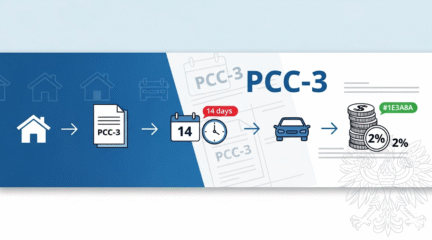
- Settle the tax obligations. The company files a PCC-3 declaration (if the capital increase is taxable) within 14 days of passing the resolution. The shareholder reports income in their annual CIT-8 or PIT-38 return.
Based on our experience at Progress Holding, the most frequent delays occur at steps four and five — incomplete contribution documentation or formal deficiencies in the KRS filing result in court notices and extend the process by several weeks. We prepare the full documentation package to prevent this.
What are the corporate income tax (CIT) consequences of converting a shareholder loan?
Converting a shareholder loan to share capital is, in principle, tax-neutral for the company — contributions to share capital are not taxable income under Article 12(4)(4) of the Polish CIT Act. However, complexity arises when the nominal value of the newly issued shares is lower than the amount of the loan being converted.
Consequences for the company
If new shares are issued with a nominal value lower than the loan, Poland’s Supreme Administrative Court (NSA) has consistently held that the difference constitutes taxable income — treated as partial debt forgiveness under Article 12(1)(2) of the CIT Act. This is the primary tax trap in loan-to-equity conversions. A safe conversion matches the nominal value of new shares exactly to the loan amount.
Consequences for the shareholder
The shareholder-lender recognises taxable income equal to the nominal value of the shares received (Art. 12(1)(7) CIT Act for corporate shareholders; Art. 17(1)(9) PIT Act for individuals). This amount may not be lower than the fair market value of the receivable on the transfer date. The cost base is the value of the receivable contributed, capped at the nominal value of the shares (Art. 15(1j)(2a) CIT Act).
Accrued interest
If accrued but unpaid interest is included in the conversion, the shareholder recognises interest income at the point of capitalisation. The company cannot deduct unpaid interest as a tax cost under Article 16(1)(11) of the CIT Act. From our work on hundreds of such transactions, the decision to include interest always requires an individual analysis — in some cases, settling interest separately in cash before the conversion is more tax-efficient.
Is a loan-to-equity conversion subject to civil law transactions tax (PCC)?
Any increase in share capital — regardless of how it is funded — is generally subject to civil law transactions tax (PCC) at 0.5% of the increase value under Articles 1(3)(2) and 7(1)(9) of the PCC Act. The tax obligation falls on the company and arises on the date the shareholders’ resolution is passed.
When is the conversion exempt from PCC?
Article 9(11)(b) of the PCC Act exempts from tax any amendment to the articles of association related to a capital increase, provided two conditions are met: the increase is funded by an unrepaid shareholder loan, and the original loan was previously subject to PCC or an equivalent capital contribution tax in another EU member state. In practice: shareholder loans made after 1 January 2009 are exempt from PCC under the EU Directive 2008/7/EC implementation — meaning the conversion of such loans to share capital does not qualify for the exemption, and the 0.5% PCC applies to the capital increase.
| Scenario | PCC on the original loan | PCC on conversion | Legal basis |
|---|---|---|---|
| Shareholder loan made after 1 January 2009 | Exempt (Art. 9(10)(i) PCC Act) | 0.5% of capital increase | Art. 7(1)(9) PCC Act |
| Shareholder loan made before 2009, PCC paid at the time | Subject to PCC (historical rate) | Exempt from PCC | Art. 9(11)(b) PCC Act |
| Foreign shareholder loan from an EU country, capital tax paid abroad | Subject to EU capital contribution tax | Exempt from PCC | Art. 9(11)(b) PCC Act |
| Loan converted to share premium (not share capital) | Irrelevant | Not subject to PCC | Art. 1(3)(2) PCC Act a contrario |
Does a loan-to-equity conversion trigger VAT in Poland?
Converting a shareholder loan to share capital does not attract Polish VAT. The contribution of a monetary receivable is not a supply of goods or a service within the meaning of Article 5(1) of the Polish VAT Act. This is confirmed by consistent rulings from the Director of National Tax Information (KIS), including the ruling of 10 September 2020 (ref. 0111-KDIB2-2.4014.131.2020.3.PB).
What does this look like in practice? Insights from Progress Holding
Based on the cases we handle at Progress Holding, three mistakes account for the majority of unexpected tax costs in shareholder loan conversions.
Mistake 1 — issuing shares at a value lower than the loan
To avoid diluting shareholding ratios, some shareholders issue new shares with a nominal value below the loan amount and direct the surplus to the share premium account. Poland’s Supreme Administrative Court treats the difference as taxable income for the company — partial debt forgiveness with no cash inflow. The correct approach is to match the nominal value of new shares to the loan amount, and direct any surplus to share premium through a separate resolution.
Mistake 2 — failing to file the PCC-3 declaration
Companies often assume that because the original loan was exempt from PCC, the conversion is automatically exempt too. This is wrong. The exemption under Article 9(11)(b) only applies when the loan was previously taxed under PCC — not when it was exempt. Failing to file leads to a tax arrear with statutory interest.
Mistake 3 — skipping a valuation for the aport method
When a receivable is contributed as an in-kind asset, the tax authorities may challenge the stated value if the company was in financial difficulty at the time of the transfer. The shareholder’s income is then assessed at fair market value — which may be below the nominal loan amount — reducing the shareholder’s cost base for any future share disposal.
Progress Holding provides full legal and tax support for shareholder loan-to-equity conversions in Poland — from reviewing the loan agreement and drafting resolutions through to KRS registration and tax filings. Contact us to discuss your situation and receive a quote.
Frequently asked questions
Does a loan-to-equity conversion in a Polish sp. z o.o. require a notarial deed?
Yes, in the standard case. Both the shareholders’ resolution and the amendment to the articles of association must be executed as a notarial deed (Art. 255 § 3 KSH), as must the shareholder’s declaration of share subscription (Art. 258 § 2 KSH). The exception applies only where the articles already authorise the management board to increase share capital up to a defined amount within a specified period.
What value goes on the PCC-3 return for a loan conversion?
Only the value by which the registered share capital increases — not the entire loan amount. Any portion directed to the share premium reserve is not subject to PCC, as confirmed by the Director of KIS in an individual ruling of 3 July 2025 (ref. 0111-KDIB2-3.4014.229.2025.1.MD). The PCC-3 must be filed within 14 days of the shareholders’ resolution.
Does an individual shareholder pay income tax on shares received in exchange for the loan?
Yes. An individual shareholder recognises capital income equal to the nominal value of the shares received (Art. 17(1)(9) PIT Act), taxed at 19% and reported in the annual PIT-38 return for the year of subscription. The cost base for future share disposal is the value of the receivable contributed, capped at the nominal value of shares.
Can only part of the shareholder loan be converted?
Yes. A partial conversion is fully permissible under Polish law. The remaining loan obligation continues and must be repaid under the original agreement or covered by a further capital increase resolution. Each partial conversion is a separate legal transaction with its own tax obligations.
How long does KRS registration of the conversion take?
The registration court has a statutory 7-day processing period for applications filed via the Court Register Portal (Art. 6946 § 1 Code of Civil Procedure). With a complete documentation package, registration typically completes within 5–10 business days. Incomplete filings are returned and extend the process considerably.
Summary
Converting a shareholder loan to share capital is an effective way to recapitalise a Polish company without deploying new cash — but only when properly structured. The key rules for 2026: the nominal value of new shares should equal the loan amount; a 0.5% PCC applies to the capital increase unless the original loan was previously subject to PCC; and the shareholder always recognises taxable income equal to the nominal value of shares received. A pre-transaction tax review costs a fraction of the exposure that results from skipping it.
Need professional support with a shareholder loan-to-equity conversion in Poland? Contact Progress Holding at +48 603 232 418 or by email at office@progressholding.pl. We will prepare your documentation, guide you through the full process, and ensure correct tax compliance at every step.