A shareholder loan to a Polish sp. z o.o. (limited liability company) is fully exempt from civil law transaction tax (PCC) under Article 9(10)(i) of the Polish PCC Act. By contrast, the same loan made to a general partnership (spółka jawna), limited partnership (spółka komandytowa), or civil law partnership (spółka cywilna) triggers PCC at 0.5% — because Polish tax law treats it as an amendment to the company agreement. The financial difference is real: on a PLN 500,000 loan, a limited partnership pays PLN 2,500 in tax; an sp. z o.o. pays nothing.
What is PCC and who has to pay it?
PCC (podatek od czynności cywilnoprawnych) is Poland’s civil law transactions tax. It applies to, among other things, loan agreements. The standard rate for loans is 0.5% of the principal, and it is the borrower — i.e. the company receiving the funds — who is liable.
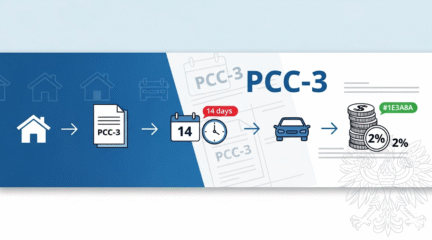
The tax obligation arises on the date the loan agreement is signed. The company then has 14 days to file form PCC-3 and pay the tax to the tax office with jurisdiction over its registered seat. The physical transfer of funds is irrelevant — the signed agreement alone triggers the obligation.
The taxable base is the loan amount. If the agreement provides for disbursement in tranches and the total is not known at signing, PCC is calculated separately on each tranche as it is paid out.
Is a shareholder loan to a Polish sp. z o.o. subject to PCC?
No. A loan extended to an sp. z o.o. by one of its shareholders is exempt from PCC. The exemption is based on Article 9(10)(i) of the PCC Act (Journal of Laws 2024, item 295) and covers loans made to capital companies — sp. z o.o., joint-stock companies (S.A.), and European companies — by their shareholders.
The exemption is unconditional. There is no requirement to file a nil PCC-3 return. There is no upper limit on the loan amount. There is no minimum interest rate. The Head of the National Revenue Information Service confirmed this in a binding ruling dated 7 May 2024 (ref. 0111-KDIB2-3.4014.108.2024.3.JKU).
Why this exemption matters for foreign founders
At Progress Holding we advise hundreds of sp. z o.o. companies set up by foreign entrepreneurs. Most start with the minimum share capital of PLN 5,000 and then inject working capital through a shareholder loan — PLN 50,000, PLN 100,000, sometimes PLN 500,000. Thanks to the PCC exemption, every złoty reaches the company without any tax leakage.
For comparison: if that same shareholder increased the share capital instead, the company would pay 0.5% PCC on the contribution. On PLN 500,000, that is PLN 2,500 — plus the cost and delay of a KRS (court registry) amendment.
Additional exclusion under Article 2(4) of the PCC Act
Independently of the Article 9 exemption, a loan may also fall entirely outside the scope of PCC if the lender is a VAT-registered taxpayer. Providing an interest-bearing loan by an active VAT payer constitutes a VAT-exempt supply of services (Article 43(1)(38) of the VAT Act). Under Article 2(4) of the PCC Act, transactions subject to VAT — including VAT-exempt ones — are excluded from PCC entirely.
In practice this creates a double safety net: even if the Article 9 exemption were somehow inapplicable, the VAT exclusion can still protect the transaction.
When does a shareholder loan attract 0.5% PCC?
PCC at 0.5% applies when the borrower is a Polish personal partnership: a general partnership (spółka jawna), limited partnership (spółka komandytowa), professional partnership (spółka partnerska), or civil law partnership (spółka cywilna). Polish tax law treats such a loan not as a loan agreement but as an amendment to the company agreement (Article 1(3)(1) of the PCC Act).
This classification is crucial. For an ordinary loan between unrelated parties, the VAT exclusion under Article 2(4) can apply. But that exclusion explicitly covers transactions “other than a company agreement and its amendments.” Because a shareholder loan to a personal partnership is classified as an amendment — the exclusion does not apply.
Tax due — examples
| Loan amount | PCC rate | Tax due | Filing deadline |
|---|---|---|---|
| PLN 50,000 | 0.5% | PLN 250 | 14 days from signing |
| PLN 100,000 | 0.5% | PLN 500 | 14 days from signing |
| PLN 200,000 | 0.5% | PLN 1,000 | 14 days from signing |
| PLN 500,000 | 0.5% | PLN 2,500 | 14 days from signing |
| PLN 1,000,000 | 0.5% | PLN 5,000 | 14 days from signing |
The taxpayer is the company (for registered commercial partnerships) or the partners jointly and severally (for civil law partnerships). The PCC-3 form must be filed with the tax office having jurisdiction over the company’s registered seat — Section E, box 4.
Does the method of transfer matter?
No. PCC is due even when no cash physically changes hands. The Head of the National Revenue Information Service confirmed this in a ruling dated 12 August 2024 (ref. 0111-KDIB2-3.4014.267.2024.5.AG): a set-off of mutual claims (for example, a partner waiving repayment of a capital contribution in exchange for the company crediting a loan) still triggers PCC.
What about a limited joint-stock partnership (S.K.A.)?
A spółka komandytowo-akcyjna (S.K.A.) is treated as a capital company for PCC purposes — even though the Polish Commercial Companies Code classifies it as a personal partnership. This follows from the Court of Justice of the EU ruling of 22 April 2015 in Case C-357/13.
Accordingly, a shareholder loan to an S.K.A. benefits from the same PCC exemption as a loan to an sp. z o.o. (Article 9(10)(i)). The Supreme Administrative Court (NSA) confirmed this in its judgment of 9 March 2021 (III FSK 2568/21). That said, tax authorities occasionally challenge this position — so it is safer either to seek an individual binding ruling or to file PCC-3 and then apply for a refund.
Tax pitfalls beyond PCC
Even a PCC-exempt shareholder loan creates obligations under corporate income tax (CIT) law and transfer pricing rules. A shareholder and the company they own are related parties within the meaning of Article 11a(1)(4) of the CIT Act.
Interest-free loan = deemed income
If a shareholder provides the company with an interest-free loan, the tax authorities will treat the foregone interest as a free-of-charge benefit (Article 12(1)(2) of the CIT Act). The company must recognise income equal to the interest it would have paid at arm’s length rates. This is one of the most common errors we encounter at Progress Holding — a “free” loan ends up generating a CIT liability.
Interest rate and the safe harbour for 2026
To ensure that the interest rate on a related-party loan is not challenged, companies can use the simplified safe harbour under Article 11g of the CIT Act. From 1 January 2026 the parameters are:
| Parameter | 2026 value |
|---|---|
| Base rate (PLN loans) | WIBOR 3M, WIRON 3M Compound Rate, or POLSTR 3M Compound Rate |
| Maximum margin — borrower | 2.6 percentage points |
| Minimum margin — lender | 2.0 percentage points |
| Maximum loan term | 5 years |
| Annual cap | PLN 20 million (aggregate with related parties) |
| Additional charges | None — interest only, no fees or premiums |
Source: Announcement of the Minister of Finance and Economy, 10 December 2025 (Monitor Polski). The key change for 2026 is the addition of POLSTR 3M alongside WIBOR 3M and WIRON 3M. Margins are unchanged from 2025.
Meeting the safe harbour conditions eliminates the need for a local transfer pricing file and protects the applied rate from challenge. The transaction must still be reported in the TPR form, but in a simplified manner.
Risk of reclassification as a capital contribution
An interest-free loan with no fixed repayment date may be reclassified by the authorities as an additional payment (dopłata) or capital contribution. A capital contribution is subject to 0.5% PCC even in an sp. z o.o. — because it is not a loan, so the Article 9(10)(i) exemption does not apply. Our standard recommendation at Progress Holding is always to specify both an interest rate and a repayment date in the agreement, even if the company does not intend to repay for several years.
PCC comparison: sp. z o.o. vs personal partnerships
| Criterion | Sp. z o.o. / S.A. / S.K.A. | General / limited / civil law partnership |
|---|---|---|
| PCC classification | Loan agreement | Amendment to company agreement (Art. 1(3)(1)) |
| PCC rate | 0% (exempt) | 0.5% |
| Basis for exemption | Art. 9(10)(i) | No exemption |
| VAT exclusion (Art. 2(4)) | Yes — additional protection | No — applies only to non-company-agreement transactions |
| PCC-3 filing | Not required | Within 14 days of signing |
| Taxpayer | — | Company (commercial) or partners jointly (civil) |
| PCC on PLN 500,000 loan | PLN 0 | PLN 2,500 |
How to document a shareholder loan correctly
A valid shareholder loan agreement must be in at least documentary form (required for amounts above PLN 1,000 under the Civil Code). This means a confirmed email exchange is technically sufficient — but in practice we always recommend a written contract.
What the loan agreement must include
- Parties — the shareholder’s details (lender) and the company’s details (borrower), including KRS number and tax ID (NIP).
- Principal amount and currency.
- Interest rate — fixed or floating (e.g. WIBOR 3M plus margin). No interest = risk of deemed income.
- Repayment date — a specific date or instalment schedule. No date = risk of reclassification as a capital contribution.
- Disbursement and repayment method — bank transfer to the company’s business account.
- Signatures — note: if the sole shareholder is also the sole member of the board, the loan agreement must be executed as a notarial deed under Article 210(2) of the Commercial Companies Code.
Shareholders’ resolution
Unless the articles of association provide otherwise, taking on a loan by an sp. z o.o. requires a shareholders’ resolution when the loan exceeds twice the share capital (Article 230 of the Commercial Companies Code). With minimum share capital of PLN 5,000, the threshold is just PLN 10,000 — meaning almost every shareholder loan requires a resolution.
In our experience at Progress Holding, skipping this resolution is one of the most common procedural errors. The contract itself remains valid, but the board member who signed it without authorisation bears personal liability.
Frequently asked questions
Is a shareholder loan to a Polish sp. z o.o. subject to PCC?
No. A loan from a shareholder (or stockholder) to a capital company — sp. z o.o., S.A., or European company — is exempt from PCC under Article 9(10)(i) of the PCC Act. No PCC-3 form needs to be filed and no formalities related to this tax are required.
How much PCC applies to a shareholder loan to a general or limited partnership?
0.5% of the loan amount. A shareholder loan to a personal partnership is classified as an amendment to the company agreement (Article 1(3)(1) of the PCC Act). The company must file PCC-3 and pay the tax within 14 days of signing.
Does a shareholder loan have to bear interest?
Formally, no — but an interest-free loan creates tax exposure. The tax office will treat it as a free-of-charge benefit and assess CIT income on market-rate interest. We recommend setting an interest rate in line with safe harbour: base rate (e.g. WIBOR 3M) plus a margin of up to 2.6 pp for the borrower.
Does the shareholder pay income tax on interest received?
Yes. Interest received on the loan is income for the lender. If the shareholder is an individual, the interest is subject to a flat 19% personal income tax (the so-called Belka tax). The company, acting as withholding agent, deducts and remits the tax when paying the interest.
Does a shareholder loan require a shareholders’ resolution?
Yes, if the loan exceeds twice the share capital (Article 230 of the Commercial Companies Code) — unless the articles of association provide otherwise. With minimum capital of PLN 5,000, the threshold is PLN 10,000, so virtually every shareholder loan requires a resolution.
Does a shareholder loan need to be reported in transfer pricing documentation (TPR)?
Yes, if the loan exceeds the documentation threshold (PLN 10 million for financial transactions between related parties). Loans covered by the safe harbour simplification are reported in the TPR form in a simplified manner and do not require a local transfer pricing file.
A shareholder loan is one of the simplest and most cost-effective ways to finance a Polish company — provided the structure fits the company’s legal form and the documentation is in order. With an sp. z o.o., PCC is avoided entirely. With a personal partnership, 0.5% applies, but it can be planned for in advance. In either case, remember: set a market-rate interest rate and put the agreement in writing.
Need professional assistance with a shareholder loan in Poland? Contact Progress Holding at +48 603 232 418 or office@progressholding.pl. We will prepare the loan agreement, shareholders’ resolution, and transfer pricing calculation — so you can be confident everything is fully compliant.