
Tax-deductible costs (koszty uzyskania przychodu) in a sp. z o.o. are expenses incurred in order to generate revenue or to preserve or protect its source, provided they do not appear in the exclusion catalogue of Article 16(1) of the CIT Act. The more properly documented costs you report, the lower the corporate income tax your company pays. Below you will find the specific rules, 2026 limits and a list of expenses the tax office will challenge.
What are tax-deductible costs under CIT?
Tax-deductible costs are expenses incurred to generate revenue from a revenue source or to preserve or protect that source, except for costs listed in Article 16(1) of the CIT Act. This is set out in Article 15(1) of the Corporate Income Tax Act of 15 February 1992 (consolidated text: Journal of Laws 2025, item 278).
The Act does not contain a closed catalogue of deductible expenses. In theory, any business-related expense can qualify — as long as it meets all four conditions at the same time.
4 conditions for deducting an expense
- Purpose — the expense was incurred to generate revenue or to preserve/protect its source.
- Business connection — there is a causal link between the expense and the company’s revenue.
- Not personal in nature — the expense does not serve the private purposes of shareholders, board members or employees.
- Not on the exclusion list — the expense is not listed in Article 16(1) of the CIT Act as a non-deductible cost.
From our experience at Progress Holding, most disputes with the tax office concern conditions 1 and 3. Business owners struggle to demonstrate the link between an expense and revenue and to separate business costs from personal ones.
What expenses can a sp. z o.o. deduct?
A sp. z o.o. can deduct any expense related to its business activity that is not listed in the Article 16(1) exclusion catalogue and is properly documented.
Typical deductible costs in a sp. z o.o.
| Cost category | Examples | Notes |
|---|---|---|
| Salaries and wages | Employee salaries, employer ZUS contributions, fees under civil-law contracts | Deductible when paid (cash method) or accrued (accrual method, if paid on time) |
| Office rent and maintenance | Rent, utilities, internet, cleaning, security | 100% deductible if premises used exclusively for business |
| Materials and goods | Raw materials, trade goods, packaging, office supplies | Deductible when goods are sold or materials consumed |
| External services | Accounting, legal, IT, marketing, transport services | 100% deductible; advisory services subject to transfer pricing rules for related parties |
| Depreciation | Depreciation charges on fixed assets and intangible assets | Limits apply for passenger cars (see table below) |
| Car — running costs | Fuel, servicing, car wash, parking, tolls | 75% if mixed use; 100% if exclusively business use (with mileage log and VAT-26 filing) |
| Business travel | Flights/train tickets, hotel, per diem allowances | Within limits set by the business travel regulation |
| Insurance | Motor TPL, comprehensive car insurance, property, business liability | Comprehensive insurance — proportional limit for cars above the depreciation cap |
| Loan and credit interest | Interest paid on working capital and investment loans | Only when paid; accrued but unpaid interest is NOT deductible |
| Training and education | Courses, conferences, employee training | Must relate to the employee’s job responsibilities |
| Advertising | Google Ads, Meta Ads, promotional materials, business cards | 100% deductible — advertising is not entertainment |
As part of our accounting services at Progress Holding, we ensure every expense is properly classified. Ongoing accounting for a sp. z o.o. starts at PLN 799 net per month — this includes verification of cost documents and advice on what can safely be deducted.
What expenses are not tax-deductible?
The catalogue of excluded expenses is set out in Article 16(1) of the CIT Act. The list contains over 60 items. Below are the most relevant ones for sp. z o.o. companies.
Key excluded expenses — Article 16(1) of the CIT Act
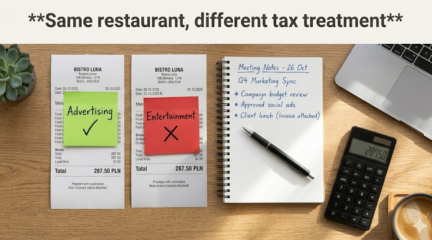
- Entertainment expenses (Article 16(1)(28)) — spending on lavishness and ostentation, e.g. exclusive dinners with contractors, expensive wines, luxury gifts. Note: an ordinary business lunch at a restaurant is not entertainment — it is an advertising or marketing cost. The line can be blurred and depends on the circumstances.
- Fines and financial penalties (Article 16(1)(15)) — penalties imposed in criminal, fiscal criminal, administrative and misdemeanour proceedings.
- Accrued but unpaid interest (Article 16(1)(11)) — interest on liabilities, loans and credits that has been accrued but not yet paid or has been waived.
- Depreciation above the car limit (Article 16(1)(4)) — the portion of depreciation calculated on a car value exceeding the applicable cap.
- Donations and gifts (Article 16(1)(14)) — all donations, with the exception of food donated for charitable purposes (under statutory conditions).
- CIT itself (Article 16(1)(15)) — corporate income tax is not a deductible cost.
- Land acquisition costs (Article 16(1)(1)(a)) — except perpetual usufruct fees. Land cannot be depreciated.
- Enforcement costs (Article 16(1)(17)) — costs related to failure to meet obligations.
- One-sided benefits to shareholders (Article 16(1)(38)) — unilateral shareholder benefits. If the benefit is reciprocal (e.g. remuneration for work performed for the company), it may be deductible.
- Related-party loan interest above the limit — restricted by thin capitalisation rules (Article 15c of the CIT Act).
In our clients’ practice, the most common issues are distinguishing entertainment from advertising and classifying passenger car expenses. These are the two areas where the tax office most readily challenges costs during audits.
What are the 2026 car cost limits for passenger vehicles?
From 1 January 2026, three depreciation and lease caps apply to passenger cars, depending on CO₂ emission levels. The new limits are introduced by the amended Article 16(1)(4) of the CIT Act.
| Vehicle type | CO₂ emissions | Depreciation/lease cap from 2026 | Cap until end of 2025 |
|---|---|---|---|
| Electric / hydrogen car | 0 g/km | PLN 225,000 | PLN 225,000 |
| Low-emission plug-in hybrid (PHEV) | Below 50 g/km | PLN 150,000 | PLN 150,000 |
| Combustion engine / standard hybrid | 50 g/km and above | PLN 100,000 | PLN 150,000 |
Cars entered into the fixed-asset register by 31 December 2025 retain the previous limits. The new PLN 100,000 cap applies to vehicles registered from 1 January 2026. The Ministry of Finance has confirmed that for operating leases and rentals, the new limits apply even to agreements signed before 2026.
Passenger car running costs in a company
- 100% of running costs — if the car is used exclusively for business. Requirements: keeping a mileage log (ewidencja przebiegu pojazdu) and filing form VAT-26 with the tax office.
- 75% of running costs — if the car is used for mixed purposes (business and private). This is the default option when no mileage log is kept.
We have processed hundreds of company car settlements at Progress Holding and know that keeping a mileage log is only worthwhile with intensive business use. For most small companies, the 75% limit is the simpler and safer solution.
How to properly document costs in a sp. z o.o.
Every deductible cost must be supported by an accounting document. A sp. z o.o. keeps full accounting records (księgi rachunkowe), so documentation requirements are strict.
Accepted cost documents
- VAT invoices — the primary document confirming purchases of goods and services
- Receipts (rachunki) — from entities exempt from VAT
- Contracts — e.g. lease, rental, specific-work and mandate agreements
- Bank statements — confirming payment of interest and bank fees
- Insurance policies — confirming insurance costs
- Accounting notes — for internal settlements
- Payroll records — documenting employee salaries
- Internal evidence — in limited scope (e.g. travel expense reports)
A missing or incomplete document (e.g. without the buyer’s NIP) is the most common reason for an expense being struck off during an audit. The tax office will not recognise a cost you cannot document.
What is the difference between a direct and indirect cost — and why does it matter?
Direct costs are expenses that can be attributed to a specific revenue item. Indirect costs are general operating expenses that cannot be allocated to a single transaction.
When to recognise the cost for CIT
| Cost type | Examples | When to recognise for CIT |
|---|---|---|
| Direct cost | Purchase of trade goods, production materials | In the tax year in which the corresponding revenue is earned |
| Indirect cost | Rent, admin salaries, accounting fees, advertising | On the date incurred (invoice date or other document date) |
| Indirect cost spanning more than one year | Annual insurance, multi-year subscription | Proportionally over the period it covers |
Correctly distinguishing direct from indirect costs affects when they are recognised in the CIT return. A classification error can result in understated or overstated tax advances in a given period — and that triggers late-payment interest.
What does this look like in practice? Progress Holding’s experience
Based on our accounting services for over 400 sp. z o.o. companies at Progress Holding, we have identified the most common mistakes in classifying deductible costs.
Most common cost errors — Progress Holding data
| Error | Frequency | Consequence |
|---|---|---|
| Classifying entertainment as advertising | 31% | Cost disallowed during audit + interest on the tax shortfall |
| No distinction between mixed use and business-only car | 24% | Running costs overstated by 25% (100% instead of 75%) |
| Booking invoices unrelated to the company’s activity | 18% | Cost challenged + fiscal criminal risk (falsification of records) |
| Recognising a cost in the wrong reporting period | 15% | CIT return amendment + possible interest |
| Ignoring the car depreciation cap | 12% | Depreciation charges overstated in costs |
We catch over 70% of these errors during ongoing bookkeeping — before the data reaches the CIT return. That is the advantage of a professional accounting firm over self-managed books. If you need a VAT or CIT return amendment, we handle it for PLN 250 net.
Is board member remuneration a deductible cost?
Board member remuneration is a deductible cost for a sp. z o.o., provided it has been established by a shareholders’ resolution or recorded in the articles of association and is paid for actual management duties.
If the board member is also a shareholder, Article 16(1)(38) of the CIT Act may apply — it excludes one-sided benefits to shareholders. However, remuneration for managing the company is a reciprocal benefit (the board member performs work for the company), so it typically qualifies as a deductible cost.
The key is documenting the scope of duties and the proportionality of remuneration to the work performed. The tax office may challenge compensation that is grossly inflated relative to the scope of duties — treating the excess as a disguised dividend.
Are advertising and marketing expenses deductible?
Advertising and marketing expenses are fully deductible (100%), with no monetary limit. Advertising is not entertainment — it is a separate expense category.
Advertising vs entertainment — how to tell the difference
| Feature | Advertising (deductible) | Entertainment (NOT deductible) |
|---|---|---|
| Purpose | Reaching customers, promoting products/services | Building prestige, lavishness, ostentation |
| Audience | Potential customers (broad audience) | Specific contractors, business partners |
| Examples | Google Ads, leaflets, branded merchandise, trade fairs, TV spots | Exclusive dinner, expensive wine, luxury gifts |
| Limit | No limit | Entirely excluded from costs |
A business meeting at a restaurant with a standard menu is an advertising/marketing cost (building trade relationships). An elaborate dinner at an exclusive restaurant with premium wines is entertainment. Court rulings confirm that the purpose and character of the meeting are decisive, not the venue itself.
Frequently asked questions
Are employer ZUS contributions a deductible cost?
Yes. Social insurance contributions financed by the employer (pension, disability, accident) as well as contributions to the Labour Fund and FGŚP are deductible costs for a sp. z o.o. The condition is that they must be paid on time. ZUS contributions not paid by the deadline are not deductible (Article 16(1)(57a) of the CIT Act).
Can an invoice without the buyer’s NIP be a cost?
Technically yes — a missing NIP does not automatically disqualify the expense. However, the tax office may challenge such a document during an audit. We always recommend requesting invoices with the company’s correct NIP.
Can a contractual penalty be a deductible cost?
It depends on the type of penalty. Penalties for delay in delivering defect-free goods, for product defects or for late defect removal are not deductible (Article 16(1)(22) of the CIT Act). Contractual penalties on other grounds (e.g. early contract termination) may be deductible if you can demonstrate their link to revenue or protecting the revenue source.
Is spending on coffee and snacks in the office deductible?
Yes — coffee, tea and small snacks provided to employees and visitors are deductible. This is a general administrative cost related to the company’s operations, not entertainment. Tax authorities do not challenge this type of expense.
Is the accounting service fee a deductible cost?
Yes. The accounting firm’s fee is a typical indirect cost — an expense related to the company’s general operations. At Progress Holding, accounting services for a sp. z o.o. start at PLN 799 net per month. The full amount is a deductible cost for your company.
Is VAT a deductible cost for CIT?
Generally no — input VAT that is eligible for deduction is not a CIT cost. However, input VAT that the company cannot deduct (e.g. from an invoice for catering services — Article 88(1)(4) of the VAT Act) may qualify as a deductible cost for CIT purposes.
Correct classification of deductible costs is the foundation of tax optimisation for a sp. z o.o. Every error in this area means either overpaid tax (when you miss costs you are entitled to) or audit risk with interest (when you overstate costs). The best strategy: document every expense, check it against Article 16(1) of the CIT Act and consult your accountant on doubtful cases.
Need professional support in managing your company’s costs? Contact us at Progress Holding: +48 603 232 418 or office@progressholding.pl. We provide full accounting for companies, ensure correct cost classification and prepare CIT returns without errors.