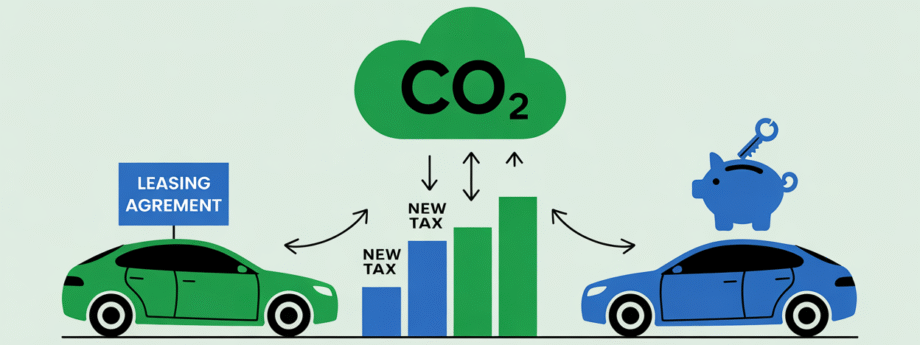

The choice between leasing and purchase depends on VAT, tax limits, and your cash flow. In 2026, tax-deductible cost (KUP) limits depend on CO₂ emissions: 100k/150k/225k PLN. Correctly setting up records allows deducting 100% VAT or 75%/20% of costs in PIT/CIT.
Will car cost limits change in 2026?
Yes. From 1.01.2026, the limit depends on CO₂ emissions: 100k, 150k, or 225k PLN. This applies to depreciation, rental, and operating leases.
Tax cost (KUP) limits – 2025 vs 2026
| Year / drive type | Tax cost limit (write-offs / capital installment) | Legal basis |
|---|---|---|
| Until 31.12.2025 – combustion and hybrid cars | 150 000 PLN | MF explanations 9.04.2020 |
| Until 31.12.2025 – electric/hydrogen cars | 225 000 PLN | MF explanations 9.04.2020 |
| From 1.01.2026 – emission ≥ 50 g CO₂/km | 100 000 PLN | Dz.U. 2021 item 2269 |
| From 1.01.2026 – emission < 50 g CO₂/km | 150 000 PLN | Dz.U. 2021 item 2269 |
| From 1.01.2026 – EV / H₂ | 225 000 PLN | Dz.U. 2021 item 2269 |
You apply the new limits to cars entered into the register from 1.01.2026. Older cars are settled under the “old” rules.
Leasing or purchase? What usually gives a lower tax and better cash flow?
Leasing often protects cash flow better, and the installment becomes a cost faster. A purchase gives full control over the fixed asset and depreciation.
Practical differences
- Operating lease: The initial fee and capital installment are included in costs, but proportionally to the 100k/150k/225k PLN limit from 2026.
- Purchase: You depreciate up to the limit. The standard rate for passenger cars is 20% annually (approx. 60 months).
- Interest: As a rule, not subject to the car’s value limit. Limits apply to the car’s value and the capital part.
How does the limit proportion work for leasing and rental?
You only add part of the capital fee to costs in proportion: limit / car value × fee. This rule also applies after 1.01.2026.
Example – leasing a combustion car in 2026
- Car value: 160 000 PLN; emission 120 g CO₂/km → limit 100 000 PLN.
- Proportion: 100 000 / 160 000 = 62.5%.
- 62.5% of each capital fee (initial fee + installments) goes into tax-deductible costs. The interest part – without limit.
How much VAT can you deduct? 50% or 100%?
Typically 50% VAT on passenger car expenses. 100% VAT requires exclusive business use and a VAT mileage log.
Conditions for 100% VAT
- Regulations excluding private use and real control.
- Vehicle mileage log for VAT purposes.
- VAT-26 declaration, if applicable.
Basis: VAT Act, art. 86a and podatki.gov.pl.
75% or 100% of operating costs in PIT/CIT?
For company cars used for mixed purposes, you include 75% of operating expenses. 100% only for exclusive business use.
Key rules
- 75% KUP (tax cost): fuel, service, tires, car wash, parking – when the car is also used privately.
- 100% KUP: when you meet the conditions for 100% VAT (exclusive use + records).
- AC (car insurance): You settle the premium using the same proportion as the car value limit.
Basis: PIT art. 23(1) points 46a, 47, CIT art. 16(1) points 51, 49.
Does an entrepreneur’s private car also generate costs?
Yes, in a sole proprietorship (JDG), a private car allows 20% KUP from operating expenses. You do not depreciate a private car not entered in the register.
Basis: PIT art. 23(1) point 46.
Does non-deductible VAT increase the initial value of the car?
Yes. Non-deductible VAT increases the initial value of the fixed asset. You calculate depreciation write-offs from the increased amount.
Basis: PIT art. 22g, CIT art. 16g.
Can a passenger car be depreciated in one-off?
No. The “de minimis” one-off depreciation does not cover passenger cars. It applies to selected groups 3–8 of KŚT, excluding passenger cars.
Basis: PIT art. 22k, CIT art. 16k.
Leasing vs. purchase – a quick tax comparison
Both options work, but the tax effects differ in the pace of cost recognition and the vehicle value limit.
| Aspect | Operating lease | Purchase (fixed asset) |
|---|---|---|
| KUP – “capital” | Proportion: limit / value × capital fees | Write-offs up to 100/150/225k PLN limit |
| KUP – interest | Generally outside the car value limit | Outside the car value limit |
| VAT | 50% or 100% (art. 86a VAT) | 50% or 100% (art. 86a VAT) |
| Operation | 75% / 100% KUP | 75% / 100% KUP |
| Cash flow | Better – cost “immediately” in installments | Slower – monthly write-offs |
What does it look like in practice? Progress Holding’s experience
Based on 300+ fleet and leasing analyses, clients most often lose costs due to a lack of records for 100% VAT. The second mistake is not applying the limit proportion to the initial fee.
Our observations and numbers
- The average “loss” of KUP without 100% VAT records is 8–12% annually of the car’s expense value.
- In 2026, cars with emissions ≥ 50 g CO₂/km will most often be subject to the 100k PLN limit. This will lower the tax shield.
- The greatest effect comes from choosing a version with emissions < 50 g CO₂/km or EV, plus having regulations and monitoring use.
Want to calculate your case? At Progress Holding, we will prepare a tax and cash flow model and implement the documentation for 100% VAT.
Frequently asked questions
Does 100% VAT automatically grant 100% costs in PIT/CIT?
No. 100% VAT requires exclusive use and records. In PIT/CIT, 100% KUP also requires exclusive use. If there is mixed use, you apply 75% KUP.
Is AC (car insurance) always a full cost?
No. You settle the AC premium in proportion to the car’s value limit (150k/225k until 2025; from 2026, 100/150/225k PLN depending on emissions/drive).
What about the buyout from leasing?
A buyout creates a fixed asset. You then depreciate it considering the limit applicable to that vehicle category and date of entry.
Does a company partner’s private car generate costs for the company?
Yes, but based on an agreement and general rules. Operating expenses in the company with mixed use are subject to 75% KUP.
Can I “expense” all fuel with mixed use?
No. 75% of the gross expense plus non-deductible VAT goes into KUP. The remaining 25% is a non-deductible cost (NKUP).
How to start without errors and gain a tax shield?
Determine the financing type based on CO₂ emissions and 2026 limits. Prepare regulations and records for 100% VAT. Calculate the limit proportion for leasing.
Need support in choosing and implementing the rules? We will do it for you at Progress Holding – from usage policy, through records, to settlement.
Government sources and legal acts
- Dz.U. 2021 item 2269 – limit changes from 2026
- VAT Act, art. 86a – 50%/100% VAT
- PIT art. 23 – 75%/20%, AC and limits
- CIT art. 16 – 75% and leasing limits
- MF explanations – passenger cars
Key takeaway: choose financing tailored to the 2026 limits and secure 100% VAT if possible. Need professional support? Contact us at Progress Holding: +48 603 232 418, office@progressholding.pl.