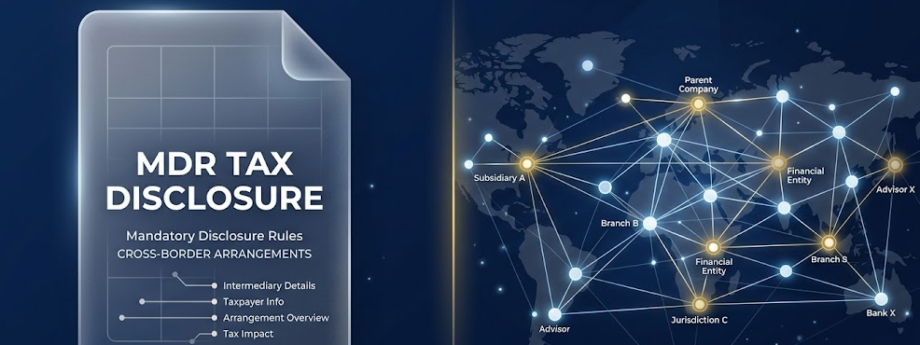

What is a reportable tax scheme under MDR?
A tax scheme is an arrangement – a single transaction or a series of related transactions – that meets at least one of three conditions: (1) it has a general hallmark and satisfies the main benefit test, (2) it has a specific hallmark, or (3) it has another specific hallmark. The legal definition is found in Article 86a § 1 point 10 of the Polish Tax Ordinance.
What counts as an “arrangement”?
An arrangement is any transaction or series of related transactions (including planned ones) where at least one party is a taxpayer, or which affect whether a tax liability arises. Even straightforward transactions – such as an intercompany loan or a change in ownership structure – can qualify as an arrangement under MDR.
Three categories of tax schemes
Polish MDR legislation distinguishes three types of schemes:
- Domestic tax scheme – covers Poland-only transactions. Reportable only when the “qualified user” threshold is met (revenues, costs, or assets exceeding EUR 10 million, or arrangement value exceeding EUR 2.5 million).
- Cross-border tax scheme – involves an international element. Always reportable regardless of transaction size – the qualified user threshold does not apply.
- Standardised tax scheme – a scheme that can be implemented by multiple users without significant modifications to its core assumptions.
In our experience at Progress Holding, many businesses operating in Poland – particularly foreign-owned companies – mistakenly assume MDR only applies to large corporations. In reality, any company engaged in cross-border transactions, including a mid-sized limited liability company (sp. z o.o.) employing staff abroad, may be subject to reporting obligations.
Which taxes are covered by MDR reporting?
MDR reporting obligations are not restricted to any single tax type. They cover direct taxes (corporate income tax – CIT, personal income tax – PIT), indirect taxes (VAT, excise duty), and local taxes (real estate tax). The only exclusion is customs duties.
Poland’s MDR rules go significantly further than the EU’s DAC6 Directive. The Polish legislature extended reporting to domestic schemes, taxes beyond direct taxation, and additional hallmarks – 24 hallmarks in total compared to the 15 set out in the Directive.
Who is obligated to report?
Reporting obligations fall on three categories of parties: the promoter, the user, and the facilitator. Each has different deadlines and reporting responsibilities.
Promoter
A promoter is any individual, legal entity, or organisational unit that designs, markets, makes available, or implements an arrangement, or manages its implementation. In practice, promoters are most commonly tax advisors, attorneys, solicitors, and bank or financial institution employees advising clients (Article 86a § 1 point 8 of the Tax Ordinance).
The promoter submits the MDR-1 information form to the Head of the National Revenue Administration within 30 days following the day the scheme is made available, prepared for implementation, or the first implementation step is taken – whichever occurs first.
User
The user is the entity (individual, legal person, or organisational unit) that implements an arrangement, to whom a scheme has been made available, or who is prepared to implement a scheme. In most cases, the user is the taxpayer – your company.
The user must file MDR-1 if the promoter has not done so (for example, due to professional secrecy obligations), or if the user has designed the scheme themselves. Additionally, the user submits MDR-3 together with the relevant tax return for each period in which the scheme was applied.
Facilitator
A facilitator is a party that provides assistance, support, or advice related to designing, organising, or implementing an arrangement – for example, an auditor, notary, accountant, chief financial officer, or bank (Article 86a § 1 point 19 of the Tax Ordinance).
At Progress Holding, we regularly see that accounting offices are caught off guard by their potential role as a facilitator under MDR. If an accountant, exercising professional diligence, should have recognised that an arrangement constitutes a tax scheme, they are required to notify the Head of the National Revenue Administration accordingly.
| Party | Role | MDR-1 filing deadline | Form(s) |
|---|---|---|---|
| Promoter | Designs, makes available, or implements the scheme | 30 days from making available / implementation | MDR-1 |
| User | Implements the scheme or obtains a tax benefit | 30 days (if promoter did not file) + MDR-3 with tax return | MDR-1, MDR-3 |
| Facilitator | Provides assistance in designing / implementing | 30 days from providing assistance / 5 days from becoming aware | MDR-1, MDR-2 |
What are hallmarks of a tax scheme?
Hallmarks are legally defined characteristics of an arrangement. Their presence – individually or in combination with the main benefit test – determines whether an arrangement constitutes a reportable tax scheme. The Tax Ordinance identifies three groups of hallmarks.
General hallmarks (11 hallmarks)
General hallmarks require the main benefit test to be satisfied simultaneously. The mere presence of a hallmark is not sufficient to trigger reporting – the arrangement must also have a tax benefit as its primary or one of its primary expected outcomes. General hallmarks include:
- Confidentiality clause – the promoter or user is required to keep the method of obtaining a tax benefit confidential
- Promoter’s fee contingent on the amount of the tax benefit (success fee)
- Use of standardised documentation or a structure available to multiple parties without significant modifications
- Conversion of income into capital, gifts, or income categories taxed at a lower rate or exempt from tax
- Round-trip transactions – funds return to the originating entity via a different legal route
Specific hallmarks (9 hallmarks)
Specific hallmarks do not require the main benefit test – their presence alone triggers the reporting obligation. They relate primarily to cross-border arrangements:
- Cross-border payments to associated entities in tax havens or non-cooperative jurisdictions
- Depreciation of the same asset claimed in more than one jurisdiction
- The same income benefiting from double tax treaty relief in multiple countries simultaneously
- Asset transfers where the consideration differs between jurisdictions by at least 25%
- Circumventing automatic exchange of financial account information (CRS/FATCA)
- Structures that make it difficult to identify the beneficial owner
Other specific hallmarks (4 hallmarks)
These are a Polish extension to the DAC6 Directive, applying where monetary thresholds are exceeded:
- Impact on deferred income tax exceeds PLN 5 million in a calendar year
- Hypothetical withholding tax (WHT) would exceed PLN 5 million if no tax treaty or exemption applied
- Income of a non-resident CIT taxpayer exceeds PLN 5 million per year and has been shifted between jurisdictions
- Difference between Polish and foreign tax results exceeds PLN 5 million per year
What is the main benefit test?
The main benefit test (Article 86a § 2 of the Tax Ordinance) is satisfied when a reasonably acting person, pursuing objectives other than a tax benefit, would have chosen a different course of action. At the same time, the tax benefit must be the primary or one of the primary benefits the party expects to derive from the arrangement.
The main benefit test applies exclusively in combination with general hallmarks. For specific and other specific hallmarks, the arrangement is reportable regardless of whether obtaining a tax benefit was the primary objective.
When is a domestic scheme not reportable?
A domestic tax scheme is only reportable when the qualified user threshold is met (Article 86a § 4 of the Tax Ordinance). This threshold is satisfied when at least one of the following conditions applies:
- The user’s revenues, costs, or asset value exceeded the equivalent of EUR 10 million in the current or preceding year
- The value of the arrangement exceeds EUR 2.5 million
- The user is an associated entity of a party meeting the above conditions
If none of these conditions are met, the domestic scheme does not need to be reported. Important note: for cross-border schemes, the qualified user threshold is irrelevant. Cross-border schemes must always be reported, regardless of the company’s size.
Which MDR forms need to be filed?
The MDR reporting system comprises four forms: MDR-1 (scheme notification), MDR-2 (notification of informing the user), MDR-3 (notification of scheme application), and MDR-4 (quarterly notification for standardised schemes). All forms are submitted electronically via mdr.mf.gov.pl.
| Form | Filed by | When | Purpose |
|---|---|---|---|
| MDR-1 | Promoter / user / facilitator | 30 days from making available or implementation | Initial notification of an identified tax scheme; upon filing, the Head of the National Revenue Administration assigns a Tax Scheme Number (NSP) |
| MDR-2 | Promoter / facilitator | Promoter: 30 days from informing the user; facilitator: 5 days from becoming aware | Notification that the user has been informed of their reporting obligation |
| MDR-3 | User | By the deadline for filing the relevant tax return | Notification of tax scheme application or tax benefit obtained; requires signatures from all management board members |
| MDR-4 | Promoter / facilitator | 30 days after the end of each quarter | Quarterly notification listing entities to whom a standardised scheme was made available |
What penalties apply for failing to report?
Non-compliance with MDR obligations can result in two types of penalties: criminal fiscal sanctions (for individuals) under Article 80f of the Fiscal Penal Code, and administrative fines (for entities) under Article 86m of the Tax Ordinance. Both types of penalties can apply simultaneously.
Criminal fiscal penalties
- Fine of up to 720 daily rates – for failure to submit scheme information, late submission, or failure to provide details of users of a standardised scheme
- Fine of up to 240 daily rates – for using an invalidated Tax Scheme Number (NSP)
- Minor offence fine – in cases of lesser severity
- Business ban – courts may impose this additional penalty upon conviction under Article 80f of the Fiscal Penal Code
Administrative fines
- Up to PLN 2 million – for failure to implement an internal MDR procedure by an obligated entity (Article 86m § 1 of the Tax Ordinance)
- Up to PLN 10 million – an increased fine where the absence of an internal procedure coincides with a final criminal conviction of an employed promoter under Article 80f of the Fiscal Penal Code (Article 86m § 2 of the Tax Ordinance)
Based on our experience at Progress Holding supporting hundreds of businesses, tax authorities are increasingly scrutinising MDR compliance during tax and customs-tax audits. Unreported schemes are frequently identified when transfer pricing documentation, intangible service arrangements, or transactions with foreign entities are reviewed.
Who is required to have an internal MDR procedure?
Entities that are promoters, that employ promoters, or that effectively pay promoters’ fees, and whose revenues or costs exceeded the equivalent of PLN 8 million in the previous financial year, are required to implement an internal MDR procedure (Article 86l of the Tax Ordinance).
What must an internal MDR procedure cover?
An internal procedure should specify:
- Rules for identifying tax schemes – who assesses whether an arrangement is reportable, when, and how
- Allocation of responsibility across each stage of the reporting process
- Internal deadlines – to ensure the statutory 30-day deadline is met
- Documentation retention and archiving rules for MDR forms
- How users are informed of their reporting obligations
Even if your business is not formally required to have an MDR procedure, implementing one voluntarily forms part of a sound compliance policy and may be taken into account as a mitigating factor in the event of an audit.
Which transactions most commonly trigger MDR reporting?
Reporting obligations arise for arrangements that satisfy the hallmarks defined in the Tax Ordinance. In practice, these most commonly involve cross-border transactions, group restructurings, and non-standard tax optimisation structures.
Examples of transactions subject to MDR reporting
- Transfers of trademarks or intellectual property rights between associated entities in different jurisdictions
- Corporate group restructurings involving the transfer of functions, assets, or risks across borders
- Use of double tax treaties to reduce withholding tax
- Changes of tax residency to access a lower tax rate
- Cross-border intragroup financing (loans, cash pooling) with a tax benefit element
- Transitions from employment to self-employment (sole trader) where subordination indicators are present
- Structures using holding companies in jurisdictions with favourable tax regimes
What is not a tax scheme?
Merely claiming a tax relief, choosing a tax form (for example, the flat 19% income tax rate), or benefiting from a statutory exemption does not automatically create a tax scheme. A scheme requires specific hallmarks to be present – and for domestic schemes, the qualified user threshold must additionally be met.
Common MDR compliance mistakes we see in practice
Based on our accounting and advisory work with over 500 businesses at Progress Holding – including foreign-owned companies and groups with cross-border activity – we have identified five recurring MDR compliance failures.
Mistake 1: Failure to identify the MDR obligation at all
Around 40% of businesses whose accounting we take over have never assessed whether their transactions might constitute tax schemes. This is particularly common among companies with foreign shareholders that regularly make cross-border payments to associated entities – transactions that frequently satisfy specific hallmarks.
Mistake 2: Confusing reporting with aggressive tax planning
Many business owners assume MDR only concerns “aggressive tax optimisation”. In fact, MDR is a disclosure obligation – it can apply to entirely lawful and commercially routine transactions that simply happen to satisfy one or more hallmarks.
Mistake 3: Missing the 30-day deadline
The 30-day window from the date a scheme is made available or implemented passes quickly. Companies without internal scheme identification procedures often discover their obligation after the deadline has already passed – which constitutes a criminal fiscal offence under Article 80f of the Fiscal Penal Code.
Mistake 4: MDR-3 not signed by the full management board
The MDR-3 form requires the signatures of all members of the user’s management board. Missing even one signature renders the form invalid. In companies with multi-member boards, this is a common administrative oversight.
Mistake 5: Overlooking the facilitator role
Accountants and bookkeeping offices frequently do not realise they may qualify as facilitators under MDR. If, applying professional diligence, they should have identified an arrangement as a tax scheme, they are obligated to notify the Head of the National Revenue Administration within 5 days of becoming aware.
Frequently asked questions
Does MDR apply to small businesses?
Domestic schemes apply only to businesses meeting the qualified user threshold (revenues, costs, or assets exceeding EUR 10 million, or arrangement value exceeding EUR 2.5 million). However, cross-border schemes must be reported regardless of company size. A small sp. z o.o. (limited liability company) transacting with a foreign associated entity may well have an obligation to file MDR-1.
How long do I have to file MDR-1?
30 days from the day following the date on which the scheme is made available, prepared for implementation, or the first implementation step is taken – whichever occurs first. Missing this deadline constitutes a criminal fiscal offence under Article 80f § 1 of the Fiscal Penal Code.
Does every tax benefit mean there is a tax scheme?
No. A tax scheme requires specific hallmarks to be present. Simply using tax reliefs, depreciation, or choosing your tax form does not trigger a reporting obligation. The main benefit test asks whether a reasonable party would have chosen a different course of action were it not for the tax benefit.
Where do I file MDR forms?
MDR-1, MDR-2, MDR-3, and MDR-4 forms are filed electronically via the Ministry of Finance’s dedicated platform at mdr.mf.gov.pl. Forms must be signed with a qualified electronic signature or trusted profile (Profil Zaufany) by an authorised representative.
Can an accounting office be a facilitator?
Yes. An accounting office, bookkeeper, auditor, notary, or chief financial officer may qualify as a facilitator if, exercising professional diligence, they should have identified an arrangement as a tax scheme. The facilitator’s reporting obligation is independent of whether the promoter has already filed MDR-1.
What changed in MDR from 2026 onwards?
A draft amendment to the Tax Ordinance dated 28 March 2025 proposes exempting attorneys, solicitors, tax advisors, and patent attorneys from MDR reporting obligations on grounds of professional secrecy (implementing CJEU rulings). In such cases, the reporting obligation shifts to the user. The amendment also proposes abolishing the requirement to maintain an internal MDR procedure and narrowing the overall scope of reporting.
How to protect your business from MDR penalties
MDR compliance affects both advisors and the businesses they serve. You don’t need to be an MDR specialist – but you do need to know when to seek professional advice. Review your transactions for reportable hallmarks, particularly any cross-border activity. Implement an internal procedure, even if you are not strictly required to do so. Monitor the 30-day MDR-1 deadline and ensure that MDR-3 is signed by every member of your management board.
At Progress Holding, we help businesses identify MDR obligations, prepare the required forms, and implement internal MDR procedures. We work with foreign-owned companies, holding group structures, and businesses engaged in cross-border transactions. Need support? Contact us at +48 603 232 418 or office@progressholding.pl.