

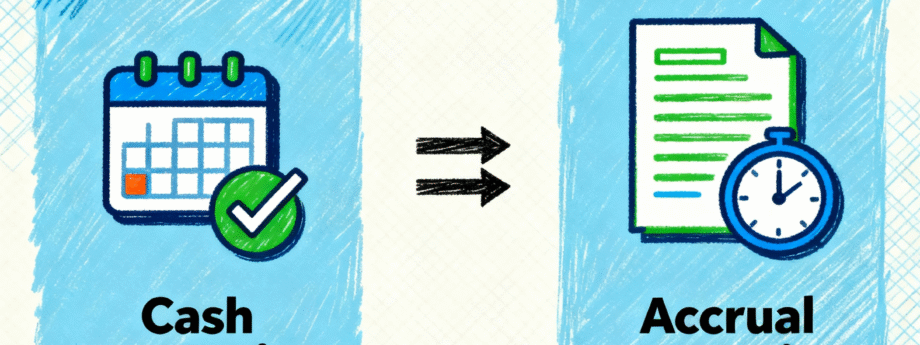

Starting from 2026, the revenue threshold allowing cash-basis accounting will increase from 1 million to 2 million zloty. This means a larger group of entrepreneurs will be able to choose cash-basis accounting instead of accrual accounting. Each method has different consequences for your company’s cash flow and tax payment timing.
What’s the difference between cash and accrual accounting?
The basic difference lies in when you record expenses in the books. Cash-basis accounting lets you deduct an expense only after actually paying the invoice. Accrual accounting requires you to record the expense when the invoice is issued, regardless of whether you’ve paid it.
Cash-basis accounting – simplified
In cash-basis accounting, you record expenses on the day they occur, usually on the invoice or receipt date. You don’t divide expenses into direct and indirect. You enter all expenses at once in the tax book of revenues and expenditures.
- You record expenses on the document issue date
- No distinction between direct and indirect expenses
- Year-end expenses are entered in a single entry
- Easier bookkeeping and fewer formalities
Accrual accounting
Accrual accounting requires you to divide all expenses into direct and indirect. Direct expenses are those linked to a specific revenue – for example, purchasing inventory for resale. Indirect expenses relate to the general operation of your business.
- You record direct expenses in the year you earned the related revenue
- You allocate indirect expenses proportionally to the period they cover
- Year-end expenses require proportional allocation
- More detailed bookkeeping, higher formal requirements
Who can choose cash-basis accounting in 2026?
From January 2026, you can use cash-basis accounting if your 2025 revenue didn’t exceed 2 million zloty. This doubles the current 1 million zloty threshold.
Additional conditions include:
- You operate a sole proprietorship (you can employ workers)
- You didn’t keep double-entry accounting books
- You submitted a written declaration to the tax office by February 20, 2026
Cash-basis PIT is available to entrepreneurs reporting under the progressive tax scale, flat tax, or lump-sum tax. If you start business activities during the year, you submit your declaration by the 20th day of the month following the month you start.
When cash-basis accounting doesn’t work – key exclusions
Cash-basis accounting has significant limitations. You can’t apply it to all transactions.
Transactions excluded from cash-basis accounting
| Transaction type | Accounting rule |
|---|---|
| Sale and purchase of fixed assets | Always accrual accounting with depreciation |
| Intangible and intellectual property | Always accrual accounting |
| Transactions with individuals (B2C) | Standard accrual accounting |
| Related-party transactions | Accrual accounting |
| Transactions with tax haven entities | Accrual accounting |
Cash-basis accounting applies only to business-to-business transactions (B2B) documented with invoices. If you sell goods or services to private individuals, you must report revenue when the invoice is issued or payment is received, following standard rules.
How do you account for expenses at year-end?
Invoices issued at year-end are a common trap in accounting. How you record them depends on your chosen method.
Example: Company vehicle insurance
You received an invoice in December 2025 for vehicle liability insurance costing 2,400 zloty. The policy covers January through December 2026.
Cash-basis method: You record the full 2,400 zloty expense in December 2025, on the invoice date. You don’t divide the expense by periods.
Accrual method: You must allocate the expense proportionally. In December 2025, you record 0 zloty (the policy only applies to 2026). You record the full 2,400 zloty in 2026, either proportionally at 200 zloty per month or in one entry in January 2026.
Direct vs. indirect expenses in accrual accounting
If you use accrual accounting, you must classify every expense.
Direct expenses – linked to specific revenue:
- Inventory purchases
- Production materials
- Subcontractor costs for specific projects
- Production worker wages
Indirect expenses – linked to general business operations:
- Office rent
- Utility bills (electricity, internet)
- Business insurance
- Marketing expenses
- Company vehicle fuel
You record direct expenses in the year you earned the related revenue. If you bought inventory in November 2025 and sold it in January 2026, you record the purchase cost in 2026.
What are the consequences of incorrect expense accounting?
Incorrect expense accounting can result in tax audits and financial penalties.
Possible consequences
- Additional income tax on incorrectly deducted expenses
- Interest on tax arrears calculated from the due date
- Tax penalty from 175 to 3,500 zloty for minor amounts
- Fine for tax violations exceeding 8,750 zloty for serious breaches
- Criminal tax proceedings for intentional tax evasion
The most common errors found during audits are:
- Missing proper invoices and supporting documents
- Incorrect classification of direct and indirect expenses
- Incorrect year-end expense allocation
- Disproportionate division of multi-period expenses
Which method is better for your business?
The choice of method depends on your business type and payment structure with clients.
Cash-basis accounting works best when:
- Your clients pay late (30-90 days)
- You run a small business with revenue up to 2 million zloty annually
- You value accounting simplicity
- You want to improve cash flow and avoid paying tax before receiving payment
- Most transactions are B2B with other businesses
Accrual accounting is better when:
- Your revenue exceeds 2 million zloty annually
- You have access to capital and stable financing
- You generate thousands of transactions monthly
- You need accurate financial analysis and reporting
- You primarily sell to consumers (B2C)
Remember that once you choose a method, you must apply it throughout the tax year. You can switch to a different method only in the next year after notifying the tax office by February 20.
How does this work in practice? Progress Holding experience
Based on analysis of over 800 companies served by Progress Holding from 2023-2025, we’ve noticed clear trends in expense accounting method choices.
Our data shows:
- Only 12% of entrepreneurs eligible for cash-basis accounting chose it in 2025
- The main reason for rejection was concern about complex B2C transaction accounting
- 47% of firms with revenue between 1 and 2 million zloty plan to switch to cash PIT in 2026 after the limit increase
- The most common error (68% of audits) was incorrect indirect expense allocation at year-end using accrual accounting
In practice, we observe that service providers with long payment terms (60+ days) benefit most from cash-basis accounting. A company with 1.5 million zloty in revenue and an average payment term of 45 days saved approximately 18,000 zloty annually by deferring tax installment payments.
Conversely, trading companies with fast inventory turnover (7-14 day payments) see little difference between methods. For them, bookkeeping simplification matters more than cash flow optimization.
Frequently asked questions
Can I switch accounting methods mid-year?
No. You must apply your chosen method throughout the tax year. You can change methods only in the next year by submitting written notice to the tax office by February 20.
What if my revenue exceeds 2 million zloty during the year?
You can continue using cash-basis accounting through year-end. Starting next year, you lose the right to cash accounting and automatically switch to accrual accounting. You don’t need to submit any change notice.
Does cash-basis accounting apply to VAT?
No. These are separate systems. Cash-basis PIT applies only to income tax accounting. VAT is reported under separate rules per the VAT Act. You can use cash-basis VAT accounting (for small taxpayers) independently of your PIT accounting method.
How do I account for an invoice received while using cash accounting but paid after switching to accrual accounting?
You deduct the expense in the year you pay the invoice – already using accrual accounting. If you received an invoice in December 2026 using cash PIT and paid it in January 2027 after switching to accrual, you record the expense in 2027.
Can a civil partnership partner use cash-basis accounting?
No. Cash-basis accounting is available only to individuals operating sole proprietorships. Partners in partnerships (civil, general, or professional) cannot use it. This also applies to businesses in succession.
Do I have to pay for changing accounting methods?
No. Submitting a cash-basis election or notice of resignation is free. It’s a standard administrative procedure without tax fees.
Choosing the right expense accounting method directly affects your company’s cash flow and tax installment amounts. The 2026 limit increase to 2 million zloty opens this option to a significantly larger group of entrepreneurs. Before deciding, analyze your revenue structure, client payment terms, and business type.
Need professional support in choosing the best accounting method for your business? Contact us at Progress Holding: +48 603 232 418 or office@progressholding.pl. We’ll help you make the optimal choice and provide full accounting services starting from 599 zloty net monthly. We serve over 800 companies, including foreigners running businesses in Poland.


