

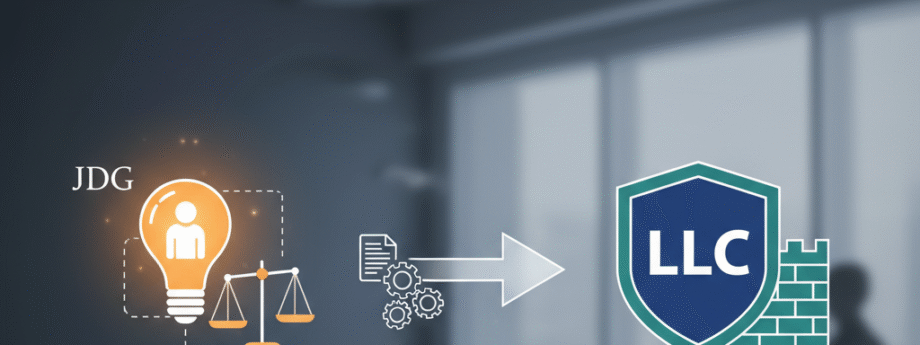

Why is it worth transforming a sole proprietorship into an LLC?
The main reasons are limiting personal liability, building a professional image, and making it easier to raise capital for development. It’s a natural step when your company is growing and generating increasing revenue.
Limiting personal liability
In a sole proprietorship, you are responsible for the company’s debts with all your private assets. An LLC limits your liability to the amount of shares you have contributed, protecting your home, savings, and other private assets.
Credibility and professional image
An LLC is perceived as a more stable and reliable business partner than a sole proprietorship. This makes it easier to establish cooperation with large contractors, participate in tenders, and build trust in the market.
Opportunities for growth and raising capital
The structure of an LLC allows for the easy admission of new partners or investors who can contribute capital for further development. This is much more difficult in the case of a sole proprietorship.
What are the methods for transforming a sole proprietorship into an LLC?
You can choose one of three paths: a formal transformation, contributing the business as an in-kind contribution (aport) to a new company, or liquidating the sole proprietorship and starting an LLC from scratch. The formal transformation is usually the most advantageous.
Each method has different legal and tax consequences. The table below compares the key aspects of these three solutions.
| Feature | Formal Transformation | In-kind Contribution of the Enterprise | Liquidation of JDG and New Company |
|---|---|---|---|
| Legal Continuity (NIP, contracts) | Full (universal succession) | Partial (requires precision) | None (everything from scratch) |
| Process Complexity | High (notary, certified auditor) | Medium (notary, valuation) | Low (two separate processes) |
| Costs | Highest (several to tens of thousands PLN) | Medium | Lowest (cost of setting up an LLC) |
| Best for | Companies with contracts, licenses, history | Specific tax scenarios | Small businesses with no liabilities |
What does the formal transformation look like step by step?
A formal transformation is a process regulated by the Commercial Companies Code, which consists of several stages and requires the participation of a notary and a certified auditor. It guarantees full legal security.
- Preparation of the transformation plan: It is prepared in the form of a notarial deed. The plan contains key information about the transformed company and the future LLC.
- Examination of the plan by a certified auditor: The court, at your request, appoints a certified auditor who examines the correctness and reliability of the transformation plan.
- Submission of the transformation statement: After receiving a positive opinion from the auditor, you submit a transformation statement to a notary.
- Appointment of bodies and conclusion of the articles of association: You appoint the first management board of the company and sign the LLC’s articles of association.
- Registration in the KRS and deletion from CEIDG: You submit an application for the registration of the transformed company in the National Court Register (KRS). On the day of registration, your sole proprietorship is automatically deleted from the Central Register and Information on Economic Activity (CEIDG).
What are the costs and how long does the transformation take?
The total cost of a formal transformation is usually between 8,000 and 15,000 PLN, and the entire process takes from 2 to 4 months. The main expenses are the certified auditor’s fee and notary fees.
The costs include: the certified auditor’s fee (approx. 3,000-6,000 PLN), notary fees (approx. 2,000-4,000 PLN), court fees (approx. 600 PLN), and the PCC tax. Due to the complexity of the process, legal and accounting support is also necessary. At Progress Holding, we offer comprehensive transformation services. Schedule an expert consultation (cost 350 PLN net) to get a detailed quote for your company.
Our Data: The most common mistakes when transforming a sole proprietorship into an LLC
Based on our experience in serving over 500 companies, we have identified mistakes that generate unnecessary costs and legal problems. Professional advice helps to avoid them.
Mistake 1: Choosing liquidation instead of transformation
The most common mistake is closing the sole proprietorship and starting a new company. This seemingly cheapest solution results in the loss of continuity of contracts, credit history, and the NIP number. As a result, you have to build relationships with contractors and banks from scratch, which is much more expensive in the long run.
Mistake 2: Underestimating the time and cost of the process
Many entrepreneurs are surprised that the transformation takes several months and requires the involvement of a certified auditor. Planning the change of legal form well in advance is crucial to avoid business interruptions and liquidity problems.
Mistake 3: Ignoring the consequences for ZUS and taxes
Switching to an LLC completely changes the rules of taxation and ZUS contributions. Failure to analyze these changes before the transformation can lead to unfavorable decisions. For example, a sole shareholder still pays ZUS, which many people forget.
Frequently Asked Questions
What happens to the NIP and REGON numbers after the transformation?
In the case of a formal transformation, the LLC retains the NIP and REGON numbers of your previous sole proprietorship. This ensures full identification continuity of the company for authorities and contractors.
Do I have to close my bank account and sign new contracts?
No. Thanks to the principle of universal succession, the LLC automatically assumes all the rights and obligations of your sole proprietorship. This means that contracts with contractors, credit agreements, or leasing agreements remain in force. You only need to inform the bank and partners about the change of legal form.
Do I still have to pay ZUS contributions after the transformation?
It depends. If you are the sole shareholder in the new LLC, you are still subject to mandatory ZUS contributions. However, if the company has at least two shareholders, this obligation generally does not arise, unless you are employed by the company under an employment contract.
What are the main tax consequences of the transformation?
The main change is the switch from personal income tax (PIT) to corporate income tax (CIT). You also need to remember about the phenomenon of so-called double taxation – first, the company pays CIT on its profit, and then you pay PIT on the dividend paid out.
Can I transform a sole proprietorship into an LLC online?
No, the formal process of transforming a sole proprietorship into an LLC requires the participation of a notary and a certified auditor. It cannot be done through the simplified online S24 procedure, which is only available when setting up a new, simple company.
Transforming a sole proprietorship into an LLC is an important decision that protects your private assets and opens up new development opportunities. Due to the complexity of the process, the support of experienced advisors is crucial. Do you want to safely transform your company? Contact us at Progress Holding at +48 603 232 418 or by email at office@progressholding.pl.


