

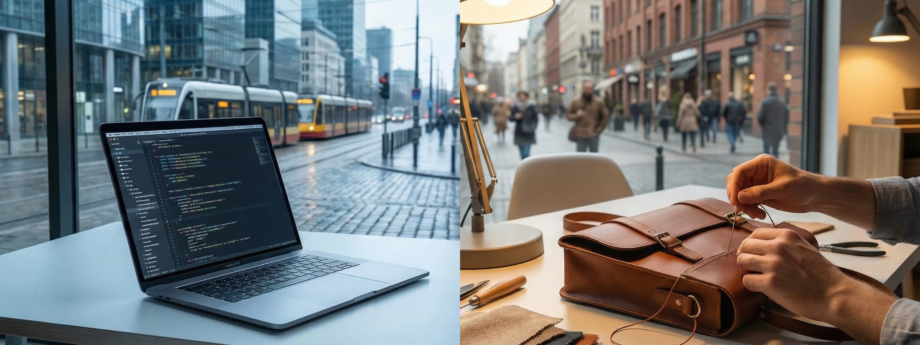
Small Business Ideas in Poland in 2026 for Foreigners

Previously on our website, we have already discussed business ideas in Poland. We reviewed various directions – business with minimal investment, business from scratch, and business with investments.
👉 You can read that article by following this link: Business Ideas in Poland 2025 (Archive)
Today we want to supplement the review with topics and ideas that would be interesting for relocators who arrived in Poland and decided to start their life in this country by opening a small business.
So, what can you build your small business on, if the market is already flooded with a huge amount of goods and services? What idea and product can interest different age groups? We explore this question below.
Let’s go!
Part 1. Business in the IT sector
Poland can be called one of the most dynamically developing IT hubs in Europe. And these are not just words: the country actively invests in technology, creates favorable conditions for business, and attracts talents from all over the world. For IT specialists and aspiring entrepreneurs from other countries, Poland is becoming an increasingly interesting destination, offering a convenient combination of opportunities and comfort.
If you are looking for a place to start a career or open your small IT business, why should you pay attention to this country?
- Firstly, it offers an excellent price-quality ratio. The cost of living and doing business here is noticeably lower than in Western Europe, which allows for more effective use of start-up capital or obtaining a higher real salary.
- Secondly, Poland is a member of the European Union, which significantly simplifies access to the huge European market for your products and services, and also makes the company opening process quite transparent, simple, and understandable, even for foreigners.
In Poland, you will find a modern business culture, fast-growing IT hubs in major cities, as well as many support programs for startups and small businesses. The combination of these factors makes Poland in 2026 an ideal place to turn your IT ambitions into reality, whether it’s launching your own startup, working in an international team, or developing your freelance project.
Let’s consider several directions for small IT business, grouped by areas:
I. Services for small and medium-sized businesses (SMB)
This is perhaps the largest and most accessible market for a start. Many small businesses need an IT expert but cannot afford a full-time employee.
1. Managed IT Services (MSP) / “Your external IT department”
- What it is: Proactive management and support of clients’ IT infrastructure (monitoring servers, workstations, networks, installing updates, backups, antivirus, technical support on demand) on a monthly subscription basis.
- Pros: Stable income, scalability, high demand.
- Who it suits: System administration specialists, network engineers, technical support specialists.
2. Web development and related services
- What it is: Creating websites (on WordPress, Tilda, Wix, or custom), landing pages, online stores (on Shopify, OpenCart, WooCommerce). Also SEO optimization, analytics, support, and updating of existing sites.
- Pros: Huge demand, possibility to work remotely, wide technology stack.
- Who it suits: Frontend and backend developers, designers, SEO specialists.
3. Cybersecurity for SMB
- What it is: Security audit, firewall configuration, implementation of protection systems, training employees in cyber hygiene basics, incident response, VPN setup, and secure remote access.
- Pros: Growing demand, high margin, critical importance for clients.
- Who it suits: Information security specialists.
4. Implementation and customization of CRM/ERP systems
- What it is: Helping businesses choose, configure, and integrate customer relationship management systems (CRM, e.g., AmoCRM, Bitrix24, Salesforce) or enterprise resource planning (ERP). Developing reports, automating business processes.
- Pros: High value for the client, long-term projects.
- Who it suits: Business analysts, developers with experience in these systems.
5. Cloud solutions and DevOps
- What it is: Migration of infrastructure to the cloud (AWS, Azure, GCP), optimization of cloud costs, CI/CD pipeline configuration, deployment automation, cloud architecture consulting.
- Pros: High demand, expert niche.
- Who it suits: DevOps engineers, system architects, cloud specialists.
6. Data services
- What it is: Collection, analysis, visualization of data (Power BI, Tableau), database configuration, ETL process development, data strategy consulting for business.
- Pros: More and more businesses realize the value of data.
- Who it suits: Data engineers, data analysts, database specialists.
II. Development of niche products (SaaS/Tools)
This is riskier, but potentially more scalable.
1. SaaS product solving a specific problem
- What it is: Developing your own web application that solves a narrow but common problem for a specific category of users or businesses. For example, a time tracking tool for freelancers, SaaS for managing small projects, a social media post scheduler for small businesses.
- Pros: Scalability, potentially high income.
- Cons: Requires a lot of effort in development, marketing, and support.
- Who it suits: Developers with an idea and entrepreneurial spirit.
2. Plugins/Themes/Extensions
- What it is: Creating and selling specialized plugins for WordPress, Shopify, other CMSs, or browser extensions that improve functionality or solve a specific task.
- Pros: Lower entry threshold than full-fledged SaaS.
- Who it suits: Developers specializing in specific platforms.
III. Development of products for AI
The development and application of Artificial Intelligence is becoming part of our daily life. This creates huge opportunities for business. Many are used to thinking that AI is the prerogative of only giant corporations with huge budgets, but in reality, this is far from the case. Today, even a small startup or individual entrepreneur can find their niche in this rapidly developing sphere.
Let’s consider several business ideas in this area:
1. Specialized data annotation and labeling for niche AI models
- Characteristics: Creating high-quality, precisely labeled datasets for very specific AI tasks. Instead of general tasks, focus on niches requiring expert knowledge (e.g., labeling medical images for a specific disease, recordings of rare languages, behavioral patterns in a narrow industry). This directly contributes to the development of more accurate and specialized AI models.
- Low cost: Main investments are your time and attention to detail. You can start with simple labeling tools and look for clients among startups or research groups needing unique data.
2. Prompt engineering and AI interaction optimization service
- Characteristics: Developing, testing, and optimizing effective “prompts” for large language models (LLM) and other generative AIs. You will help companies receive maximally useful and accurate answers from AI, build prompt chains for complex tasks, and develop strategies for integrating AI into workflows through intelligent queries.
- Low cost: Requires only access to APIs of various AI models (often there are free tiers or inexpensive subscriptions) and your ability to think creatively and analytically.
3. Micro-service for fine-tuning ready-made AI models
- Characteristics: Using existing but general AI models (e.g., from Hugging Face, OpenAI, Google) and fine-tuning them on specific client data to solve narrow tasks. For example, fine-tuning a model for sentiment analysis of comments in a specific industry, generating text in a certain corporate style, or classifying images of very specific objects.
- Low cost: You use ready-made, pre-trained models, which significantly reduces time and resources for development. The main work is preparing data for fine-tuning and setting up the process.
4. Development of niche AI agents/plugins to expand AI functionality
- Characteristics: Creating small but powerful AI agents or plugins that expand the capabilities of existing AI platforms (e.g., plugins for ChatGPT, specialized agents based on AutoGPT or LangChain). These can be agents for automating specific business tasks, integrating AI with external services, or performing complex multi-step operations.
- Low cost: Focus on creating small, modular solutions. Using open libraries and APIs. You sell not the whole system, but an “add-on” that significantly increases the value of the main AI platform.
5. Creating specialized technical content and educational materials on AI development
- Characteristics: Developing high-quality, practical guides, courses, video lessons, or articles focusing on specific, current aspects of AI development. Monetization through paid subscriptions, course sales, donations.
- Low cost: Main investments are your time, knowledge, and ability to explain complex material in an accessible way.
These ideas allow you to use your deep knowledge in IT and AI without requiring significant initial investments, while actively contributing to the development of the artificial intelligence sphere itself.
Part 2. Small productions
Poland continues to remain an attractive destination for relocation, offering a stable economy, access to European markets, and a dynamically developing business environment. For those who come from other countries and dream not just of working as an employee but of creating something of their own, 2026 opens new perspectives. The demand for unique, high-quality, and personalized goods is growing, so low-budget production can become an ideal entry point into the Polish market for a foreign entrepreneur.
Let’s consider several interesting ideas for small productions that a novice entrepreneur can implement in Poland.
1. Atelier for the production of reusable textile products for home and personal care
Idea: Creating and producing eco-friendly, durable, and aesthetically attractive alternatives to disposable products. These can be:
- Reusable cotton pads and face sponges: Made of bamboo, organic cotton, flannel.
- Shopper bags and bags for vegetables/fruits: Made of natural fabrics, with author’s prints or embroidery.
- Wax wraps for food storage: Eco-friendly replacement for cling film.
- Textile pads and diapers: For those looking for maximally natural solutions.
- Decorative pillows and textiles for interiors: Made of recycled fabrics or with unique patterns.
- Designer clothes.
Why it is relevant in 2026: Growing ecological consciousness and the trend for sustainable consumption in Poland create a high demand for such goods. The possibility of personalization (choice of fabric, embroidery of initials) makes the product unique.
Low budget: Start-up investments include a sewing machine, overlocker, purchase of fabrics, accessories, and packaging materials. Production can be set up even at home.
For relocators: An opportunity to bring unique patterns and styles characteristic of your culture or focus on minimalist design, which is popular in Europe.
2. Workshop for making author’s spices and sauces (or “ethnic” sauces)
Idea: Creating a small production of unique spices, sauces, marinades, and pâtés based on local Polish products or “ethnic” sauces, bringing unique tastes and culinary traditions. The emphasis is on author’s recipes, natural ingredients, and the absence of preservatives and dyes.
These can be:
- Author’s spice mixes: Unique compositions for meat, poultry, fish, vegetables, or baking, created from local herbs, wild mushrooms, or traditional ethnic components.
- Sauces and chutneys: Based on regional fruits and berries combined with unusual spices, or authentic ethnic sauces adapted to local taste.
- Marinades and dressings: For salads, kebabs, fermented products, prepared from natural oils, vinegars, herbs, and spices.
- Plant-based pâtés and dips: Made from legumes, root vegetables, mushrooms with unique flavor combinations.
Why it is relevant in 2026: Growing interest in healthy eating, natural products without artificial additives, and a desire to experiment with new tastes. Consumers are increasingly looking for unique, craft products.
Low budget: Start-up investments can be minimal. Basic equipment – a good blender, coffee grinder (for spices), pots. Ingredients can be purchased directly from local farmers or at markets. Production can be started in a home kitchen, obtaining necessary permits (Sanepid).
For relocators: This is an ideal niche for introducing unique culinary traditions and recipes from your culture.
3. Handmade productions
“Smart” Digital Life Organizers
- What it is: Thoughtful, stylish organizers for all our numerous gadgets, wires, adapters, flash drives, headphones, etc.
- Problem: Wires constantly get tangled, lost, look untidy.
- Solution: A functional, beautiful, personalized organizer helping to maintain order in “digital chaos”.
- Target audience: Students, office workers, freelancers, travelers.
- Aesthetics: Minimalism, clean lines, geometric patterns.
- Examples: Roll-up cable cases; Modular desktop organizers; Travel cosmetic bags adapted for electronics.
“Tactile” Anti-Stress Objects and “Digital Detox” Accessories
- What it is: Things designed to distract us from screens, give hands something to crumple, touch, feel. Needed as a “physical anchor”.
- Solution: Objects that stimulate tactile sensations, help relax and focus on the moment.
- Examples: Sensory “stones” or “toys” filled with buckwheat, rice, lavender; “Cozy” pillows for neck/back.
Continuing the theme of tactility and sensory development (for children):
- Textile/sensory handmade books (Soft/Sensory Books): Creating a soft book from different materials where each spread is dedicated to a separate sensation or interactive element.
- Educational mat or arch with pendants DIY: The base can be ready-made, and you can sew or crochet unique pendants.
- Soft toy-comforters (Loveys): Small soft toys helping the baby calm down.
Ideas related to creating memories and guest participation:
- Time capsule for the baby: A beautiful box where guests write letters with wishes for the future.
- Guest book/advice book: A notebook where guests can write their wishes.
- Station for decorating bodysuits: Guests can draw or write something on plain bodysuits.
- Hand/foot prints as art: A set for creating prints. A memory for a lifetime.
Other ideas:
- Art objects from stabilized moss (Moss Art): Creating wall panels, paintings. Eco-friendly, durable.
- Natural cosmetics with Polish/ethnic ingredients: Production of handmade soap, bath bombs, balms.
- Upcycling accessories/clothing: Remaking old clothes into new unique bags, wallets.
- Personalized gifts and decor from wood: Laser cutting/engraving of metrics, photo frames.
- Author’s scented candles/diffusers: Candles made of natural wax.
- Jewelry/accessories from epoxy resin: Pendants with dried flowers, leaves.
4. Car repair business and “handyman”
Car repair business in Poland can become an excellent opportunity. With the increase in the number of cars, the need for quality service grows.
- Mobile service: You can offer services with travel to the client or work from your own garage.
- Investments: Tools, jack, diagnostic scanner.
- Marketing: “Word of mouth”, local groups, OLX.
Another interesting idea is the “handyman” (husband for an hour) business. Many people need help with small household tasks.
- Use your skills: If you have basic knowledge in electricity, plumbing, furniture assembly, you already have the main capital.
- Basic tool set: Screwdrivers, wrenches, hammer, drill.
- No office: Your office will be the client’s home.
- Key to success: Punctuality, accuracy, politeness.
5. Franchising ideas
Let’s consider several interesting and inexpensive franchising ideas in Poland for relocators:
- Coffee to go. Requires minimal investment in equipment and rent.
- House cleaning services. Requires low initial investments and can be easily scaled.
- Healthy food store. Opening a small store with organic products.
- Courses for children. Organizing courses (drawing, music). Franchise can provide a ready-made curriculum.
Opening a low-budget business in Poland is a real chance for those looking for independence. With the right approach, these enterprises can become a stable source of income.
Opening any business in Poland is an attractive opportunity for foreign investors thanks to a stable economy.
If you have questions about how to start a business, we will be happy to share our experience!
Write to office@progressholding.pl

PL: Leszek Woronowicz posiada wieloletnie, bogate doświadczenie w obszarze finansów, bankowości oraz doradztwa biznesowego, zdobyte zarówno w Polsce, jak i za granicą.
Brał czynny udział w zakładaniu spółek akcyjnych oraz spółek z ograniczoną odpowiedzialnością w Polsce i na Ukrainie, pełniąc rolę doradcy dla międzynarodowych podmiotów, m.in. dla Nestlé Ukraine.
Pracował w szeregu instytucji bankowych, w których kierował m.in. Departamentem Skarbu oraz Departamentem Bankowości Korporacyjnej. Pełnił funkcję członka zarządu jednego z banków poza granicami kraju, a także był stałym członkiem komitetu kredytowego i komitetu ALCO.
Specjalizuje się w ocenie wiarygodności kredytowej przedsiębiorstw, obejmującej analizę bilansów, rachunków wyników oraz przepływów pieniężnych (cash flow) dużych spółek. Posiada również rozległe doświadczenie w analizowaniu dokumentów księgowych oraz ocenie ryzyk prawnych związanych z działalnością przedsiębiorstw i transakcjami finansowymi.
Dysponuje szeroką wiedzą w zakresie rynku instrumentów finansowych, kredytowania oraz rynku kapitałowego. Jako doradca uczestniczył w przygotowaniu memorandum informacyjnych dla dwóch spółek zagranicznych debiutujących na rynku NewConnect. Doradza przedsiębiorstwom w budowaniu skutecznych modeli biznesowych, wspierając je w realizacji strategii rozwoju i ekspansji rynkowej.
EN: Leszek Woronowicz has many years of extensive experience in finance, banking, and business consulting, gained both in Poland and abroad.
He actively participated in establishing joint-stock companies and limited liability companies in Poland and Ukraine, acting as an advisor for international entities, including Nestlé Ukraine.
He has worked at several banking institutions, where he managed, among others, the Treasury Department and the Corporate Banking Department. He served as a board member of a bank outside of Poland and was also a permanent member of the credit committee and the ALCO committee.
He specializes in assessing the creditworthiness of enterprises, which includes the analysis of balance sheets, profit and loss accounts, and cash flows of large companies. He also has extensive experience in analyzing accounting documents and evaluating legal risks associated with business activities and financial transactions.
He has broad expertise in the financial instrument market, lending, and the capital market. As an advisor, he participated in preparing information memorandums for two foreign companies making their debut on the NewConnect market. He advises companies on building effective business models, supporting them in implementing development strategies and market expansion.
RU: Лешек Воронович обладает многолетним, обширным опытом в сфере финансов, банковского дела и бизнес-консалтинга, полученным как в Польше, так и за рубежом.
Он принимал активное участие в создании акционерных обществ и обществ с ограниченной ответственностью в Польше и на Украине, выступая в роли консультанта для международных организаций, включая Nestlé Ukraine.
Работал в ряде банковских учреждений, где руководил, среди прочего, Казначейским департаментом и департаментом корпоративного банкинга. Являлся членом правления одного из банков за пределами страны, а также был постоянным членом кредитного комитета и комитета ALCO.
Специализируется на оценке кредитоспособности предприятий, включая анализ балансовых ведомостей, отчетов о прибылях и убытках, а также денежных потоков (cash flow) крупных компаний. Также обладает широким опытом анализа бухгалтерских документов и оценки юридических рисков, связанных с деятельностью предприятий и финансовыми сделками.
Обладает широкими знаниями в области рынка финансовых инструментов, кредитования и рынка капитала. В качестве консультанта участвовал в подготовке информационных меморандумов для двух иностранных компаний, дебютировавших на рынке NewConnect. Консультирует предприятия по построению эффективных бизнес-моделей, поддерживая их в реализации стратегий развития и рыночной экспансии.
View also

Wednesday January 14th, 2026
Small Business Ideas in Poland in 2026 for Foreigners

Tuesday January 13th, 2026
Outsourcing accounting in 2026 – does it pay off for an international company?

Wednesday January 7th, 2026