

VAT in Poland: rates, refund and everything you need to know about the tax

Table of contents:
Three letters that follow you on every receipt in Poland – VAT. You pay extra VAT for milk, VAT for gasoline, even for bread – there it is again. What is VAT and why do store prices always include this addition? Let’s break everything down step by step, and even show how tourists can get some of their money back.
What is VAT in simple terms
VAT is Value Added Tax. In Polish – Podatek od towarów i usług, abbreviated PTU, but everyone uses the English abbreviation VAT (Value Added Tax).
Imagine a chain: a farmer grew wheat, sold it to a miller. The miller made flour, sold it to a baker. The baker baked bread, sold it to you. At each stage the product became more expensive – value was added. And tax is paid on each added value. That’s VAT.
Why this affects regular people
Formally, VAT is paid by businesses, but in reality… right, we pay it. The store simply includes the tax in the product price. See 10 PLN on the price tag? That means about 1.87 PLN of it is VAT, which the store will later give to the state.
VAT what is it for a regular buyer? It’s the reason why:
- Prices in Poland are higher than manufacturers think
- The receipt always shows the tax rate
- Businesses are so concerned about VAT invoices
- You can get some money back when exporting goods
VAT rates in Poland in 2025
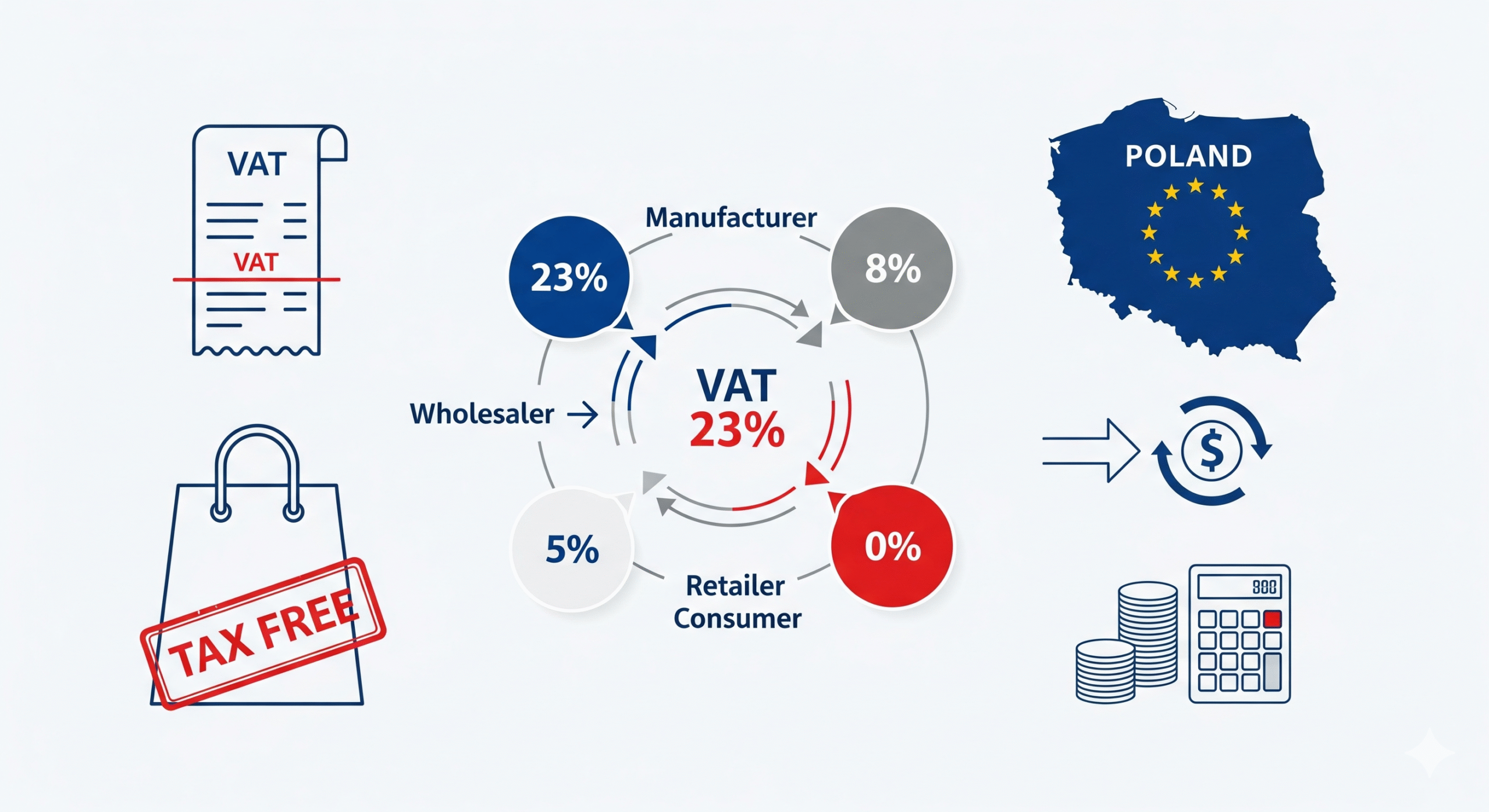
Poland doesn’t have one VAT, but a whole system of rates. VAT in Poland comes in different amounts – from 0% to 23%.
Standard rate – 23%
Most goods and services:
- Electronics and home appliances
- Clothing and footwear
- Furniture
- Cars
- Alcohol and cigarettes
- Restaurants and cafes
- Most services
Reduced rate – 8%
Socially important goods:
- Medicines and medical products
- Construction services (housing)
- Passenger transport
- Hotel services
- Admission to museums, cinemas, theaters
- Some food products
Preferential rate – 5%
Basic food products:
- Bread and bakery products
- Dairy products (most)
- Meat and fish (unprocessed)
- Fruits and vegetables (fresh)
- Books and magazines
Zero rate – 0%
Rare, but exists:
- Export of goods outside the EU
- International transportation
- Some medical services
- Specialized textbooks
Note! Since 2024, some products have been temporarily moved to 0% rate due to inflation. This can change at any time.
Who must pay VAT
Not everyone who sells something has to deal with VAT. There are clear rules.
Mandatory VAT registration
Must register:
- Companies with turnover over 200,000 PLN per year
- All limited liability companies (Sp. z o.o.) – regardless of turnover
- Sellers of certain goods (scrap metal, gold)
- Those who trade with other EU countries
VAT exemption
May not pay:
- Sole proprietors with turnover below 200,000 PLN
- Doctors, dentists (most services)
- Educational services
- Insurance and financial services
- Apartment rental (long-term)
But! Even if exempt, they can voluntarily register. Why? To deduct input VAT from expenses.
How tourists can get VAT refund
Now the most interesting part – how to get VAT refund in Poland if you’re a tourist. Yes, it’s real, and you can get back up to 23% of your purchases!
Tax Free refund conditions
To get VAT back in Poland, you need:
- Be a resident of a non-EU country
- Buy goods worth at least 200 PLN on one receipt
- Export goods within 3 months
- Not use them in the EU
- Get a customs stamp when leaving
Step-by-step refund instructions
Step 1: Shopping
In a store with “Tax Free Shopping” sign, say you want a refund. Show your passport, get a special Tax Free form.
Step 2: Filling the form
The seller fills out the form, you check the data. Be sure to keep the receipt and form!
Step 3: At the border
When leaving the EU, go to customs BEFORE checking in luggage. Show:
- Passport
- Tickets
- Goods (may be requested)
- Tax Free forms
- Receipts
Step 4: Getting money
After customs stamp, go to refund point (usually at airport). Money is paid in cash or to card. They charge 10-20% commission.
Where Tax Free doesn’t work
- Food products
- Alcohol and tobacco (there are limits)
- Services
- Goods used in the EU
VAT payer registration
If you run a business in Poland, sooner or later you’ll face the need for VAT registration.
Registration procedure
Submit to tax office (Urząd Skarbowy):
- VAT-R application (for companies)
- Company data
- Turnover forecast
- Bank details
Registration usually takes 1-2 weeks. You receive a NIP with PL prefix for VAT operations.
Obligations after registration
Becoming a VAT payer, you must:
- Issue VAT invoices
- Keep records of purchases and sales
- Submit declarations (usually monthly)
- Pay the difference between collected and paid VAT
- Store documents for 5 years
Sounds complicated? It is. That’s why most entrepreneurs outsource this to accountants. By the way, Progress Holding specialists have been helping with VAT registration and management for foreign entrepreneurs in Poland for over 21 years.
Declarations and reporting
It’s not enough to register – you need to report regularly.
Types of VAT declarations
- VAT-7 – basic monthly declaration
- VAT-7K – quarterly (for small companies)
- VAT-UE – for intra-EU transactions
- JPK_VAT – electronic transaction register
Filing deadlines
- Monthly – by the 25th of the following month
- Quarterly – by the 25th after the quarter
- JPK_VAT – together with declaration
Late? Fine from 280 to 1120 PLN. And if you didn’t pay the tax itself – also interest.
How to pay less (legally)
- Deduct all input VAT from business purchases
- Correctly apply preferential rates
- Use cash method (for small companies)
- Optimize timing of purchases and sales
Common mistakes and penalties
VAT is no joke. Tax office checks thoroughly and fines generously.
Common entrepreneur mistakes
- Wrong rate – applied 5% instead of 8%. Additional payment + fine
- Backdated invoices – not allowed! Fine up to 100% of VAT amount
- Deducting personal expenses – bought TV for home as “for office”
- Lost documents – no invoice = no deduction
- Missed deadlines – even one day = fine
What tax office checks
Special attention to:
- Large VAT deductions
- Constant VAT refunds
- Transactions with “risky” contractors
- Mismatch between turnover and VAT
- Cash transactions over 15000 PLN
How to avoid problems
- Keep accurate records of all operations
- Check contractors on “white list”
- Keep ALL documents
- When in doubt – consult
- Use professional accounting
Frequently asked questions
What is VAT on the receipt?
These are lines showing VAT rate and tax amount. For example, “VAT 23% – 4.67 PLN” means that 4.67 PLN of the product price is tax at 23% rate.
Can you deduct VAT when buying a car?
If buying for business and you’re a VAT payer – yes, you can deduct. If as a private person for export – theoretically yes, but the procedure is complicated.
Do I need to provide NIP when purchasing?
Only if buying for company and want a VAT invoice. For regular receipt NIP is not needed.
How to check if a company is a VAT payer?
Ministry of Finance website has “Biała lista” (white list). Enter NIP and see status. Or ask to show VAT-R certificate.
What happens if I don’t register on time?
Fine + VAT assessment for entire period + interest. Can amount to tens of thousands of PLN. Don’t risk it!
Need help with VAT and taxes?
Progress Holding company specializes in business tax support. We’ll help with VAT registration, tax optimization, reporting. Over 21 years working with foreign entrepreneurs in Poland.
📞 +48 603 232 418
✉️ office@progressholding.pl
Trust VAT to professionals!

PL: Leszek Woronowicz posiada wieloletnie, bogate doświadczenie w obszarze finansów, bankowości oraz doradztwa biznesowego, zdobyte zarówno w Polsce, jak i za granicą.
Brał czynny udział w zakładaniu spółek akcyjnych oraz spółek z ograniczoną odpowiedzialnością w Polsce i na Ukrainie, pełniąc rolę doradcy dla międzynarodowych podmiotów, m.in. dla Nestlé Ukraine.
Pracował w szeregu instytucji bankowych, w których kierował m.in. Departamentem Skarbu oraz Departamentem Bankowości Korporacyjnej. Pełnił funkcję członka zarządu jednego z banków poza granicami kraju, a także był stałym członkiem komitetu kredytowego i komitetu ALCO.
Specjalizuje się w ocenie wiarygodności kredytowej przedsiębiorstw, obejmującej analizę bilansów, rachunków wyników oraz przepływów pieniężnych (cash flow) dużych spółek. Posiada również rozległe doświadczenie w analizowaniu dokumentów księgowych oraz ocenie ryzyk prawnych związanych z działalnością przedsiębiorstw i transakcjami finansowymi.
Dysponuje szeroką wiedzą w zakresie rynku instrumentów finansowych, kredytowania oraz rynku kapitałowego. Jako doradca uczestniczył w przygotowaniu memorandum informacyjnych dla dwóch spółek zagranicznych debiutujących na rynku NewConnect. Doradza przedsiębiorstwom w budowaniu skutecznych modeli biznesowych, wspierając je w realizacji strategii rozwoju i ekspansji rynkowej.
EN: Leszek Woronowicz has many years of extensive experience in finance, banking, and business consulting, gained both in Poland and abroad.
He actively participated in establishing joint-stock companies and limited liability companies in Poland and Ukraine, acting as an advisor for international entities, including Nestlé Ukraine.
He has worked at several banking institutions, where he managed, among others, the Treasury Department and the Corporate Banking Department. He served as a board member of a bank outside of Poland and was also a permanent member of the credit committee and the ALCO committee.
He specializes in assessing the creditworthiness of enterprises, which includes the analysis of balance sheets, profit and loss accounts, and cash flows of large companies. He also has extensive experience in analyzing accounting documents and evaluating legal risks associated with business activities and financial transactions.
He has broad expertise in the financial instrument market, lending, and the capital market. As an advisor, he participated in preparing information memorandums for two foreign companies making their debut on the NewConnect market. He advises companies on building effective business models, supporting them in implementing development strategies and market expansion.
RU: Лешек Воронович обладает многолетним, обширным опытом в сфере финансов, банковского дела и бизнес-консалтинга, полученным как в Польше, так и за рубежом.
Он принимал активное участие в создании акционерных обществ и обществ с ограниченной ответственностью в Польше и на Украине, выступая в роли консультанта для международных организаций, включая Nestlé Ukraine.
Работал в ряде банковских учреждений, где руководил, среди прочего, Казначейским департаментом и департаментом корпоративного банкинга. Являлся членом правления одного из банков за пределами страны, а также был постоянным членом кредитного комитета и комитета ALCO.
Специализируется на оценке кредитоспособности предприятий, включая анализ балансовых ведомостей, отчетов о прибылях и убытках, а также денежных потоков (cash flow) крупных компаний. Также обладает широким опытом анализа бухгалтерских документов и оценки юридических рисков, связанных с деятельностью предприятий и финансовыми сделками.
Обладает широкими знаниями в области рынка финансовых инструментов, кредитования и рынка капитала. В качестве консультанта участвовал в подготовке информационных меморандумов для двух иностранных компаний, дебютировавших на рынке NewConnect. Консультирует предприятия по построению эффективных бизнес-моделей, поддерживая их в реализации стратегий развития и рыночной экспансии.
 Tax Return in Poland and Tax Refund Guide 2026 – Complete Instructions for Individuals and Companies
 Split payment in Poland — when it’s mandatory and how it affects your cash flow
 International invoicing – rules for issuing invoices to foreign clients
 VAT-EU registration in 2026 – a guide for companies conducting intra-community trade
 Bad debt relief in Polish VAT — how to recover tax on unpaid invoices
 E-commerce accounting in 2026 – specifics of online store settlements
View also

Thursday October 1st, 2026
Workplace Monitoring in Poland: Employer Rights and Limitations

Wednesday September 30th, 2026
Overtime work in Poland — how to account for it, annual limits, and salary supplement

Tuesday September 29th, 2026