
Maintaining employee personnel files in Poland requires strict compliance with Polish labor law. Every employer must create a structured folder divided into five specific parts. You must also adhere to mandatory document retention periods of 10 or 50 years.
What is the legally required folder structure for employee records?
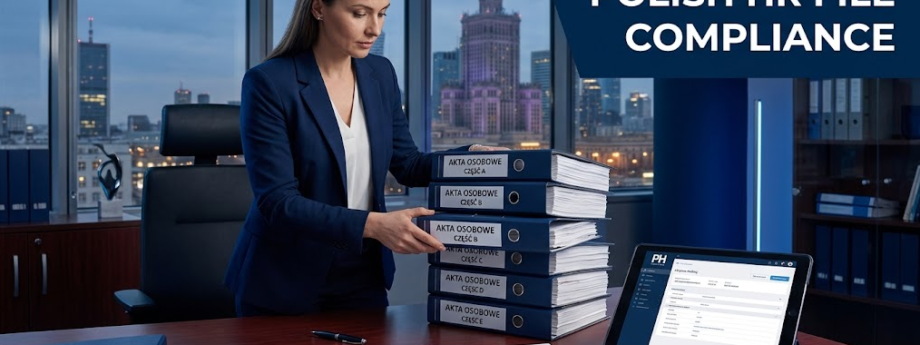
The legally required folder structure for employee records in Poland consists of five separate sections: Part A, Part B, Part C, Part D, and Part E. You must file specific documents chronologically within each corresponding section.
Polish law mandates strict categorization of all HR documents. You cannot mix different types of paperwork together. You must also number the pages consecutively within each individual section.
Part A: Recruitment and Hiring
This section holds documents related to the pre-employment phase. You must include the candidate’s CV, pre-employment medical exam results, and previous employment certificates here.
Part B: Ongoing Employment
You place employment contracts, annexes, and mandatory health and safety training records in this folder. From our experience at Progress Holding, we know that Part B grows the fastest and requires the most frequent audits. You also include declarations regarding tax deductions here.
Part C: Termination of Employment
This section contains documents linked to the end of the work relationship. You must file termination notices, mutual agreements to end employment, and copies of issued employment certificates here.
Part D: Disciplinary Measures
You store records of official penalties and disciplinary actions in Part D. This includes formal warnings or financial penalties given to the employee. You must remove these documents after one year of flawless work.
What are the current document retention periods in Poland?
The statutory document retention periods for employee records in Poland are either 10 years or 50 years. The applicable timeframe depends strictly on the specific date the employee was hired.
You must securely store all employment-related paperwork to allow employees to prove their pension rights in the future. Progress Holding offers professional archiving advisory services. Current prices and fees can always be found in the official price list on the progressholding.pl website.
| Date of Hire | Document Retention Period | Starting Point for Calculation |
|---|---|---|
| Before January 1, 1999 | 50 years | The day the employment ended |
| January 1, 1999 – December 31, 2018 | 50 years (or 10 years with OS ZUS report) | The day the employment ended |
| After December 31, 2018 | 10 years | End of the calendar year of termination |
How can you transition to electronic employee records?
Transitioning to electronic employee records requires scanning physical paper documents and signing them with a qualified electronic signature. You must formally inform your employees about the digitization process before destroying the physical copies.
Polish labor law fully permits the digitization of HR files. You must use specialized HR software that guarantees data security and chronological ordering. We have conducted hundreds of such processes and we know that proper initial categorization saves weeks of work during actual digitization. The software must allow exporting records in standard XML formats.
What documents must you include in Part E of the personnel file?
Part E of the personnel file must contain documents related to remote work agreements and employer-conducted sobriety controls. The government officially introduced this section into Polish labor law in 2023.
If your company allows remote work, you must store the employee’s location declarations here. You also place protocols from random sobriety tests in this specific section. You can find detailed regulatory guidelines regarding these checks on official government portals like biznes.gov.pl.
What are the financial penalties for missing HR documents?
Employers face fines ranging from 1,000 PLN to 30,000 PLN for missing HR documents or improperly maintained files. The National Labor Inspectorate (PIP) issues these financial penalties directly during official company audits.
Failing to keep accurate employee personnel files is a serious legal offense in Poland. You must secure all files against loss, damage, or unauthorized access. Progress Holding provides regular HR and payroll audits to ensure your company avoids these costly fines.
How does it look in practice? Progress Holding’s experience
In the practice of our clients, we most often see critical errors in chronologically numbering documents within Part B of the personnel file. Many foreign employers also fail to update mandatory periodic health check records on time.
Proper file maintenance prevents disputes during PIP inspections. You need a systemic approach to file updates to manage an active workforce. At Progress Holding, we handle the entire HR and payroll administration for foreign entities operating in Poland. We keep your documentation perfectly aligned with local laws.
Frequently Asked Questions
Who can access an employee’s personnel file?
Only authorized HR personnel, the employer, and state inspectors can access an employee’s personnel file. The employee also has the absolute right to view their own records and request copies at any time.
Can I keep personnel files in English?
No, you cannot keep personnel files exclusively in English. Polish labor law requires all official HR documents to be drawn up in Polish, though bilingual versions are fully acceptable and highly recommended for foreigners.
Do I need to keep rejected CVs in the personnel file?
You do not place rejected CVs in the personnel file. You must permanently delete or destroy them immediately after the recruitment process ends to comply with strict GDPR regulations.
What happens to the files if my company goes bankrupt?
If your company goes bankrupt, you must transfer all employee records to a specialized commercial archiving facility. The state archivist must formally approve this transfer to ensure long-term document retention.
Proper folder structure and strict adherence to document retention periods protect your company from severe legal consequences. Regularly auditing your employee personnel files in Poland guarantees compliance and peace of mind. Do you need professional support? Contact us at Progress Holding at +48 603 232 418 or email office@progressholding.pl.