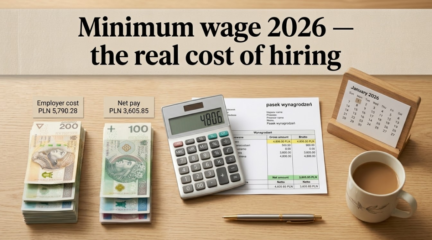

Starting in 2026, health insurance contributions (składka zdrowotna) for entrepreneurs in Poland are going up. The minimum assessment base is now 100% of the minimum wage (PLN 4,806), up from 75% in 2025. For lump-sum taxpayers, the new reference figure is the average salary of PLN 9,228.64 from Q4 2025. Entrepreneurs on progressive tax or flat tax will pay at least PLN 432.54 per month. Lump-sum payers — from PLN 498.35 to PLN 1,495.04. Below you’ll find exact rates, thresholds, and deduction rules for each tax form.
Why are health insurance contributions higher in 2026 than in 2025?
Two factors are driving the increase: the expiry of the temporary 75% preference and the rise in Poland’s minimum wage to PLN 4,806 gross.
The 75% minimum wage preference has expired
During the 2025/2026 contribution year (February 2025 – January 2026), the minimum assessment base was calculated at 75% of the minimum wage. This was a temporary relief measure introduced under transitional provisions. From 1 February 2026, it no longer applies. The new minimum base is 100% of the minimum wage in effect on the first day of the contribution year — PLN 4,806.
Presidential veto blocked reform
In spring 2025, the Polish parliament passed a bill introducing a new two-component health contribution mechanism. The reform envisaged a flat-rate contribution (9% of 75% of the minimum wage) plus an “adjusted” portion — 4.9% of income exceeding 1.5 times the average salary. The President vetoed the bill. The Ministry of Health confirmed that no further legislative work is underway. As a result, the rules from the Polish Deal (Polski Ład) remain in effect from 2026 — but with a higher minimum base.
At Progress Holding, we handle accounting for hundreds of sole traders and limited liability companies in Poland. Many entrepreneurs only learned about the expiry of the 75% relief in January 2026, when they saw higher amounts in their ZUS declarations. That’s why we’ve prepared this guide with exact figures.
Scale of the increase — 2025 vs 2026 comparison
| Parameter | 2025 (Feb–Jan) | 2026 (Feb–Jan) | Change |
|---|---|---|---|
| Minimum wage | PLN 4,666 | PLN 4,806 | +PLN 140 |
| Minimum base (progressive/flat tax) | PLN 3,499.50 (75%) | PLN 4,806 (100%) | +PLN 1,306.50 |
| Minimum monthly contribution | PLN 314.96 | PLN 432.54 | +PLN 117.58 (+37%) |
| Annual increase (minimum) | — | — | +PLN 1,411 |
The 37% year-on-year increase affects every entrepreneur on progressive or flat tax — even those running at a loss.
How much is the health contribution on progressive tax in 2026?
On progressive tax (skala podatkowa), the 2026 health contribution is 9% of business income, with a minimum of PLN 432.54 per month (9% × PLN 4,806).
How it’s calculated
The assessment base is the income from the month preceding the payment month, calculated cumulatively from the start of the calendar year. If income is low or negative, the entrepreneur pays the minimum contribution. The contribution year runs from 1 February 2026 to 31 January 2027.
January 2026 contribution — the exception
The contribution for January 2026 (due by 20 February) is still the final month of the old 2025/2026 contribution year. The minimum base for January is PLN 3,499.50 (75% of the 2025 minimum wage), making the minimum contribution PLN 314.96. The higher rate of PLN 432.54 applies from the February 2026 contribution onward.
Tax deduction — none available
Entrepreneurs on progressive tax are the only group with no right to deduct the health contribution whatsoever — neither from income nor from tax. The entire amount is a pure cost of doing business.
How much is the health contribution on flat tax in 2026?
On flat tax (podatek liniowy), the 2026 health contribution is 4.9% of income, with a minimum of PLN 432.54 per month. The annual deduction cap is PLN 14,100.
Rate and minimum contribution
Flat-tax entrepreneurs pay 4.9% of their business income. The minimum contribution is the same as for progressive tax: 9% of the minimum wage, i.e. PLN 432.54 from February 2026. For January 2026, it remains PLN 314.96. The contribution year runs from 1 February 2026 to 31 January 2027.
Deduction cap — PLN 14,100 in 2026
Under Article 30c(2)(2) of the PIT Act, flat-tax entrepreneurs may deduct paid health contributions. The 2026 cap is PLN 14,100 (announced by the Minister of Finance on 12 December 2025). In 2025, the cap was PLN 12,900 — an increase of PLN 1,200.
Two deduction methods — which one to choose?
Entrepreneurs can apply the PLN 14,100 deduction in one of two ways:
- Include it as a tax-deductible expense in KPiR (revenue and expense ledger) — this reduces both the tax base and the health contribution base in subsequent months.
- Deduct it from income when calculating PIT advance payments — this reduces only the tax base and has no effect on the contribution base.
Based on our experience at Progress Holding, the expense method is more beneficial. When the full PLN 14,100 cap is used, the expense method generates total savings of approximately PLN 3,370 per year (PLN 2,679 in tax + approximately PLN 691 in lower health contributions). The income deduction method saves only PLN 2,679.
| Deduction method | PIT savings | Health contribution savings | Total benefit |
|---|---|---|---|
| Expense in KPiR | PLN 2,679 | ~PLN 691 | ~PLN 3,370 |
| Deduction from income | PLN 2,679 | PLN 0 | PLN 2,679 |
How much is the health contribution on lump-sum tax in 2026?
On lump-sum tax (ryczałt ewidencjonowany), the 2026 health contribution is 9% of a base that depends on the revenue bracket: PLN 498.35 (up to PLN 60,000 revenue), PLN 830.58 (PLN 60,001–300,000), or PLN 1,495.04 (over PLN 300,000).
Revenue thresholds and rates
The calculation is based on the average monthly salary in the enterprise sector for Q4 2025, announced by the Central Statistical Office (GUS) on 22 January 2026, at PLN 9,228.64 (including profit distributions).
| Annual revenue | Assessment base | Base amount 2026 | Monthly contribution 2026 | Monthly contribution 2025 | Change |
|---|---|---|---|---|---|
| up to PLN 60,000 | 60% of average salary | PLN 5,537.18 | PLN 498.35 | PLN 461.66 | +PLN 36.69 |
| PLN 60,001–300,000 | 100% of average salary | PLN 9,228.64 | PLN 830.58 | PLN 769.43 | +PLN 61.15 |
| over PLN 300,000 | 180% of average salary | PLN 16,611.55 | PLN 1,495.04 | PLN 1,384.97 | +PLN 110.07 |
The maximum annual health contribution on lump-sum tax in 2026 is PLN 17,940.48 (PLN 1,495.04 × 12) — PLN 1,320.84 more than in 2025.
Contribution year and annual settlement
For lump-sum taxpayers, the contribution year matches the calendar year (January–December). This is an important difference from progressive and flat tax, where the contribution year runs February–January. Entrepreneurs must track their cumulative revenue. Once a threshold is crossed (e.g. PLN 60,000), the contribution for that month must already be paid at the higher rate.
An annual settlement takes place after the year ends. If revenue exceeded a higher bracket during the year, the difference must be paid. The payment deadline is one month after the annual tax return filing deadline.
Simplified method for lump-sum payers
Entrepreneurs who ran their business for all 12 months in 2025 on lump-sum tax may choose to pay a fixed contribution throughout 2026 based on their 2025 revenue. If 2026 revenue exceeds a higher bracket, the difference is settled in the annual reconciliation.
Deduction — 50% from revenue
Lump-sum payers may reduce their taxable revenue by 50% of the health contributions they’ve paid. This is the only form of relief available on lump-sum tax. Half the contribution effectively comes back as lower tax.
What about the health contribution on tax card in 2026?
The health contribution on tax card (karta podatkowa) in 2026 is fixed at PLN 432.54 per month (9% of the minimum wage of PLN 4,806).
Tax card holders may deduct 19% of paid health contributions from their tax. This is the only form of tax card that still exists — since 2022, no new applications for tax card have been accepted. Only entrepreneurs who had it before 2022 and have maintained it continuously can still use this form.
How do deduction rules compare across all tax forms in 2026?
The ability to deduct health contributions depends on your tax form. Progressive tax offers no deduction at all. Flat tax allows up to PLN 14,100 per year. Lump-sum tax — 50% of paid contributions.
| Tax form | Contribution rate | Minimum contribution (from Feb 2026) | Deduction | Deduction cap |
|---|---|---|---|---|
| Progressive tax | 9% of income | PLN 432.54 | none | — |
| Flat tax (19%) | 4.9% of income | PLN 432.54 | from income or as expense | PLN 14,100/year |
| Lump-sum tax | 9% of lump-sum base | PLN 498.35* | 50% from revenue | no cap |
| Tax card | 9% of min. wage | PLN 432.54 | 19% from tax | — |
* The lowest lump-sum contribution (60% of average salary) is PLN 498.35 — higher than the minimum on progressive/flat tax.
How to choose the best tax form in terms of health contributions?
The optimal tax form depends on your income level, cost structure, and available reliefs. There is no one-size-fits-all answer.
When does progressive tax make sense despite no deduction?
Progressive tax remains attractive when annual income stays below PLN 120,000 (the 12% bracket). The tax-free amount of PLN 30,000 and the option to file jointly with a spouse can offset the lack of health contribution deduction. Additional reliefs are also available: child credit, rehabilitation, internet expenses, and others.
When does flat tax win?
At income above PLN 120,000 per year, the fixed 19% rate plus the ability to deduct up to PLN 14,100 in contributions often results in a lower total burden than progressive tax at 32%. The higher the income, the more flat tax pays off.
Lump-sum tax — the low-cost niche
Lump-sum tax works best for entrepreneurs with low operating costs (e.g. IT contractors, consultants) and revenue up to PLN 300,000. A fixed health contribution combined with low tax rates (e.g. 12% for IT, 8.5% for services) can beat both progressive and flat tax. However, the inability to deduct business expenses means lump-sum tax is not suited for businesses with high operating costs.
In our experience at Progress Holding, the choice of tax form should be reviewed every year — before 20 January. Health contributions have become such a significant cost element that switching tax forms alone can save several thousand zlotys per year.
What about health contributions for cooperating persons in 2026?
A cooperating person (e.g. spouse, parent, child working with the entrepreneur) pays health contributions based on 75% of the average monthly salary, i.e. PLN 6,921.48. The monthly contribution is PLN 622.93 (9% × PLN 6,921.48).
This is a fixed rate, independent of the entrepreneur’s tax form. It is higher than in 2025 because the average salary used as the calculation base has increased.
Real-world experience from Progress Holding
Based on our analysis of over 280 entrepreneurs we serve at Progress Holding, we’ve identified the three most common mistakes in health contribution accounting.
Mistake 1: Not reviewing the tax form despite changes in contribution costs
As many as 35% of clients who came to us in 2025 hadn’t reviewed their tax form since the Polish Deal was introduced. Yet switching from flat tax to lump-sum (or vice versa) can save PLN 3,000–8,000 per year, depending on income and cost structure.
Mistake 2: Suboptimal deduction method for flat-tax payers
Around 20% of flat-tax entrepreneurs deduct health contributions from income instead of booking them as a business expense. As shown above, the expense method yields an additional ~PLN 691 in savings per year when the full PLN 14,100 cap is used.
Mistake 3: Failing to monitor revenue thresholds on lump-sum tax
Lump-sum payers don’t track their cumulative revenue and are caught off guard by the annual settlement. Crossing the PLN 60,000 threshold means an additional payment of PLN 3,986.76 (the difference between Bracket II and Bracket I contributions for 12 months). If you’re on lump-sum tax, check your cumulative revenue every month.
What we do for our clients
As part of our ongoing accounting services at Progress Holding (from PLN 990 net/month for limited liability companies, individual pricing for sole traders), we conduct monthly analysis of contribution burdens. We notify clients of approaching lump-sum revenue thresholds and recommend the optimal deduction method for flat-tax payers.
Key deadlines and obligations for health contributions in 2026
Entrepreneurs pay health contributions monthly by the 20th of the following month, filing the ZUS DRA declaration at the same time.
Calendar of obligations
| Obligation | Deadline | Notes |
|---|---|---|
| Monthly contribution + ZUS DRA | 20th of the following month | E.g. February contribution — due by 20 March |
| Annual settlement (progressive/flat tax) | By 20 May 2027 (for 02.2026–01.2027) | Filed as part of April’s ZUS DRA |
| Annual settlement (lump-sum tax) | By 20 March 2027 (for 01–12.2026) | Filed as part of February’s ZUS DRA |
| Tax form selection for 2027 | By 20 January 2027 | Application to tax office or CEIDG update |
| Settlement payment deadline | One month after annual return deadline | Applies to underpayments from annual settlement |
Penalties for late payment
ZUS charges statutory interest on late contributions. Persistent arrears may lead to administrative enforcement. Failing to pay health contributions does not result in loss of access to public healthcare — but it does create a growing debt to ZUS.
Frequently asked questions
Do I still have to pay if my business is running at a loss?
Yes. The health contribution is mandatory regardless of financial results. Even at a loss, you pay the minimum — PLN 432.54 per month on progressive and flat tax (from February 2026). On lump-sum tax, the contribution is based on revenue, not profit — so you’ll pay it as well.
When exactly does the higher minimum contribution start?
The higher minimum of PLN 432.54 applies from the February 2026 contribution (due by 20 March 2026). The January 2026 contribution is still calculated under the old rules — the minimum is PLN 314.96.
Are further changes to health contributions planned for 2026 or 2027?
As of publication (February 2026), the Ministry of Health is not working on any amendments. After the presidential veto, health contribution reform has reverted to the stage of political declarations. Changes could appear earliest in 2027 — but no official draft legislation exists.
Is the lump-sum health contribution based on income or revenue?
On lump-sum tax, the health contribution depends solely on revenue. Business expenses have no effect on its amount. This is a key difference from progressive and flat tax, where the base is income (revenue minus costs).
What’s the total annual increase for a flat-tax entrepreneur paying the minimum?
An entrepreneur paying the minimum will pay PLN 5,190.48 in the 2026/2027 contribution year (PLN 432.54 × 12). In 2025/2026 it was PLN 3,779.52. The difference is PLN 1,410.96 — an increase of over 37%.
Does suspending my business exempt me from the health contribution?
Yes. During a formal business suspension, no health contributions are due. The suspension must be registered in CEIDG. Once the business resumes, contributions are charged under current rules.
Summary — what you need to do as an entrepreneur
2026 brings a 37% increase in the minimum health contribution (to PLN 432.54/month on progressive and flat tax) and higher lump-sum rates (PLN 498.35–1,495.04). The planned reform was vetoed — Polish Deal rules apply with a higher base. Do three things: review which tax form is most cost-effective for you, choose the optimal deduction method (on flat tax — expense rather than income deduction), and monitor your revenue thresholds if you’re on lump-sum tax.
Need a personalised analysis of which tax form and health contribution setup works best for your situation? Contact Progress Holding at +48 603 232 418 or by email at office@progressholding.pl. We serve sole traders and limited liability companies — we’ll help you find the solution that minimises your combined tax and contribution burden.