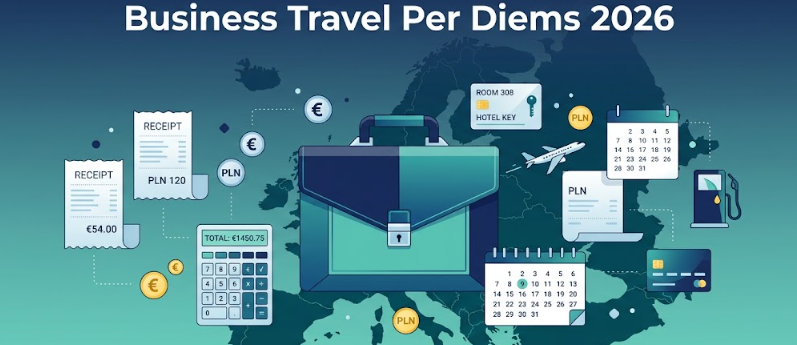

An employee sent on a work assignment outside their regular workplace is entitled to a domestic per diem of PLN 45 per day (as of February 2026), plus reimbursement for transport, accommodation, and local travel. For international trips, the per diem depends on the destination country — for example, EUR 49 in Germany, EUR 55 in France, or USD 59 in the United States. Below you will find the current rates, calculation rules, hotel limits, and documentation requirements.
What counts as a business trip under Polish law?
A business trip (podróż służbowa) is defined as carrying out a work assignment outside the employee’s regular place of work, on the employer’s instruction. The per diem is mandatory — the employee cannot waive it. The legal basis is Article 77⁵ of the Polish Labour Code.
Three conditions that must be met
For a trip to qualify as a business trip under the Labour Code, three conditions must be satisfied simultaneously:
- Employer’s instruction — the trip must be ordered by the employer, not initiated by the employee.
- Specific work assignment — the trip must have a concrete purpose (client meeting, training session, on-site installation).
- Location outside regular workplace — the employee must travel beyond the town or city specified in their employment contract as their place of work.
A daily commute to the office does not qualify. Neither does travel by a mobile worker (e.g. a sales representative) within the region defined in their contract. From our experience at Progress Holding, misclassifying trips as business travel is one of the most common HR mistakes — especially in companies with field-based employees.
How much is the domestic per diem in 2026?
The domestic per diem in 2026 is PLN 45 per day of business travel. This rate has been in effect since 1 January 2023, under the Regulation of the Minister of Family and Social Policy of 25 October 2022 (Journal of Laws 2022, item 2302).
How to calculate the per diem based on trip duration
The amount depends on how long the trip lasts. The rules differ for single-day and multi-day travel.
| Trip duration | Per diem entitlement | Amount (2026) |
|---|---|---|
| Up to 8 hours | No per diem | PLN 0 |
| 8 to 12 hours | 50% of per diem | PLN 22.50 |
| Over 12 hours | Full per diem | PLN 45 |
| Multi-day trip — each full 24-hour period | Full per diem | PLN 45 |
| Multi-day trip — remaining period up to 8 hours | 50% of per diem | PLN 22.50 |
| Multi-day trip — remaining period over 8 hours | Full per diem | PLN 45 |
When is the per diem reduced?
If the employer provides free meals during a domestic trip, the per diem is reduced accordingly. Breakfast reduces it by 25% (PLN 11.25), lunch by 50% (PLN 22.50), and dinner by 25% (PLN 11.25). When all three meals are provided, no per diem is payable. The same rule applies when the hotel rate includes breakfast.
What flat-rate allowances and limits apply to domestic travel?
In addition to the per diem, the employee is entitled to accommodation reimbursement (up to PLN 900 per night with a receipt, or a flat-rate PLN 67.50 without one), a local transport allowance of PLN 9 per day, and reimbursement for the cost of travel to the destination.
| Entitlement | Basis | Amount (2026) |
|---|---|---|
| Per diem (per day) | 100% of per diem | PLN 45 |
| Accommodation flat rate (no receipt) | 150% of per diem | PLN 67.50 |
| Maximum hotel reimbursement (with receipt) | 20 × per diem | PLN 900 |
| Local transport allowance | 20% of per diem | PLN 9 |
| Mileage — car over 900 cc | per km | PLN 1.15 |
| Mileage — car up to 900 cc | per km | PLN 0.89 |
| Mileage — motorcycle | per km | PLN 0.69 |
| Mileage — moped | per km | PLN 0.42 |
Conditions for the accommodation flat rate
The flat-rate accommodation allowance (PLN 67.50) is payable only if the overnight stay lasted at least 6 hours between 9 p.m. and 7 a.m. It does not apply when the employer provided free accommodation, the employee could have returned home, or the overnight stay took place during transit (e.g. on a sleeper train).
In practice, many of our clients at Progress Holding set a hotel spending cap lower than the statutory PLN 900 — for example PLN 350–500 per night — in their internal remuneration policy. This is permitted, provided the cap is not lower than the flat-rate amount (PLN 67.50).
What are the foreign per diem rates in 2026?
Foreign per diem rates are set per destination country in a foreign currency. The applicable rates are listed in the annex to the Regulation of the Minister of Labour and Social Policy of 29 January 2013 (Journal of Laws 2023, item 2190). The 2026 rates remain unchanged from 2023.
| Country | Per diem | Hotel limit |
|---|---|---|
| Germany | EUR 49 | EUR 170 |
| France | EUR 55 | EUR 200 |
| United Kingdom | GBP 45 | GBP 220 |
| Italy | EUR 53 | EUR 192 |
| Spain | EUR 50 | EUR 200 |
| Netherlands | EUR 50 | EUR 150 |
| Czech Republic | EUR 41 | EUR 131 |
| Lithuania | EUR 45 | EUR 130 |
| Ukraine | EUR 41 | EUR 140 |
| United States | USD 59 | USD 200 |
| Switzerland | CHF 88 | CHF 220 |
| Sweden | SEK 510 | SEK 2,000 |
How to calculate the foreign per diem
The rules differ from those for domestic travel. Each full 24-hour period abroad entitles the employee to the full per diem. For an incomplete period, the thresholds are: up to 8 hours — one-third of the per diem, 8 to 12 hours — 50%, and over 12 hours — the full amount.
Reduction for meals provided during foreign travel
If the employer covers meals during an international trip, the per diem is reduced: breakfast by 15%, lunch by 30%, and dinner by 30%. When full board is provided, the employee still receives 25% of the per diem to cover incidental expenses. If the employee receives a cash equivalent instead of meals, no per diem is payable.
When does the foreign travel period begin and end?
The starting and ending point depends on the mode of transport. For overland travel (car, bus, train), the foreign portion begins when the employee crosses the Polish border — the domestic segment is settled separately. For air travel, it begins at the moment the plane departs from the last airport in Poland. For sea travel, it begins when the ship leaves a Polish port.
What documents are required to settle a business trip?
The basic documents are a travel order issued by the employer before the trip and an expense report prepared by the employee within 14 days of returning.
Complete set of documentation
A proper business travel settlement requires the following:
- Travel order — employee details, purpose of trip, destination, departure and return dates, mode of transport, advance payment information.
- Expense report — prepared by the employee after returning: per diems, flat-rate allowances, transport costs, accommodation, and other expenses.
- Invoices and receipts — for accommodation, transport tickets, motorway tolls, and parking.
- Tickets — train, air, or bus tickets (a ticket for a journey over 50 km can substitute for an invoice).
- Vehicle mileage log — if the employee uses a private car with the employer’s consent.
- Employee’s written statement — when no receipt or invoice is available for an incurred expense.
Settlement deadline
The employee has 14 days from the end of the trip to submit the expense report with supporting documents. If an advance was drawn before the trip, it is settled within the same deadline. Any overpayment is refunded to the employee. A shortfall may be deducted from the next payroll (with the employee’s consent) or offset against a future trip advance.
Having processed hundreds of travel settlements at Progress Holding, we know the most common delay is caused by missing hotel invoices. If the employee does not produce a hotel receipt, they are automatically entitled to the flat-rate allowance of PLN 67.50 — not a reimbursement based on the actual hotel cost. The employer cannot refuse the flat rate unless the accommodation was provided free of charge.
How to record business travel costs in the books
Employee business travel costs are tax-deductible for the employer up to the limits set in the regulation. In a tax ledger (KPiR), they are entered in column 13 (“Other expenses”) on the basis of the travel expense settlement (internal document).
Recording in the tax ledger (KPiR)
The entry in the tax ledger is based on the travel expense settlement — the travel order form with the cost breakdown. Invoices, receipts, tickets, and statements are attached. Everything is entered in column 13 (“Other expenses”). The settlement form itself serves as the accounting document — no separate internal voucher is needed if it contains all the required information.
Recording in full accrual accounting
In accounting books, employee travel costs are posted as follows:
- Debit account 40 “Costs by type” → sub-account: Other operating costs — business travel
- Credit account 23-4 “Other employee settlements” → employee’s personal account
Advance settlement and reimbursement: Debit 23-4, Credit 13-0 (bank account) or 10 (cash). If the trip relates to a specific project or contract, a parallel entry is made on team 5 accounts (costs by cost centre).
Exchange rate for foreign travel expenses
Expenses incurred in a foreign currency are converted to PLN at the average NBP (National Bank of Poland) exchange rate from the last business day before the document date (invoice, receipt). Foreign per diems are converted at the NBP rate from the day before payment or settlement. Any exchange rate differences (between the advance payment rate and the settlement rate) constitute taxable income or a deductible cost.
Are per diems exempt from income tax and social security contributions?
Yes. Per diems and other allowances for employee business travel are exempt from personal income tax (PIT) and are not subject to social security contributions (ZUS) — up to the limits set in the regulation. The legal basis is Article 21(1)(16)(a) of the Personal Income Tax Act.
What about amounts above the statutory limit?
Private-sector employers may set higher per diem rates in their internal remuneration policy, collective agreement, or employment contract. However, any amount exceeding the statutory rate is treated as the employee’s taxable income, subject to both PIT and ZUS contributions. For example, if your company pays a domestic per diem of PLN 80 per day, PLN 45 is tax-exempt and the remaining PLN 35 must be taxed and subject to social security.
The per diem cannot, however, be set below PLN 45 per day for domestic travel. Article 77⁵ § 4 of the Labour Code explicitly prohibits per diems lower than the statutory rate.
What will change if the planned increase to PLN 60 takes effect?
In January 2026, the Ministry of Family, Labour and Social Policy published a draft regulation (No. 90 in the RCL register) proposing an increase in the domestic per diem from PLN 45 to PLN 60 — a 33% rise. The draft is currently undergoing public consultation and inter-ministerial review. The new rates would take effect 14 days after publication in the Journal of Laws.
How related allowances would change
| Entitlement | Current rate (PLN 45 per diem) | Proposed rate (PLN 60 per diem) |
|---|---|---|
| Per diem (per day) | PLN 45 | PLN 60 |
| Accommodation flat rate (150% of per diem) | PLN 67.50 | PLN 90 |
| Hotel limit (20 × per diem) | PLN 900 | PLN 1,200 |
| Local transport allowance (20% of per diem) | PLN 9 | PLN 12 |
The draft also proposes increases to selected foreign per diems — including for the United Kingdom (from GBP 45 to GBP 50), Czech Republic (from EUR 41 to EUR 45) and Belarus (from EUR 42 to EUR 45) — as well as higher hotel limits for many countries. For some destinations (Norway, Sweden, Denmark), the per diem currency would switch to EUR.
From our experience at Progress Holding, employers should update their remuneration policies and travel budgets before the new regulation takes effect. The draft includes transitional provisions: trips that began before the amendment are settled under the old rules, while the portion falling after the effective date follows the new ones.
Lessons from practice — Progress Holding’s experience
Based on payroll and HR administration for over 280 companies at Progress Holding — including several dozen that regularly send employees on domestic and international trips — we have identified four common mistakes in business travel settlements.
Mistake 1: no formal travel order
42% of new clients who come to us with HR issues do not issue written travel orders. Employees travel on verbal instructions, and the paperwork only appears when the accountant asks for documents. No travel order means no legal basis for the settlement — and a risk that the tax authority will disallow the expense.
Mistake 2: failing to reduce the per diem for provided meals
If the hotel rate includes breakfast, the per diem must be reduced by 25% (PLN 11.25 for domestic travel) or 15% (for international travel). Many employers overlook this. During a ZUS or tax audit, the overpaid amount is reclassified as the employee’s income — subject to PIT and social security contributions.
Mistake 3: using the wrong exchange rate for foreign travel
Employers often convert foreign per diems at the exchange rate on the departure or return date. The correct rate is the average NBP rate from the day before payment or settlement. The error results in incorrect cost recognition and potential exchange rate differences.
Mistake 4: deducting VAT from hotel invoices
Hotel and restaurant services do not entitle the buyer to deduct input VAT — Article 88(1)(4) of the Polish VAT Act. The full gross amount from the hotel invoice is recorded as a cost. We see this error in around 15% of new clients who previously handled their own bookkeeping.
Frequently asked questions
Can an employer set higher per diem rates than the statutory minimum?
Yes. Private-sector employers may set higher per diems through their remuneration policy, collective agreement, or employment contract. The domestic per diem cannot, however, be set below PLN 45. Any amount above the statutory rate is treated as the employee’s taxable income, subject to PIT and ZUS.
Is a contractor on a civil-law agreement entitled to a per diem?
The Labour Code provisions apply only to employees on an employment contract. A contractor (zleceniobiorca) may receive travel reimbursement if the civil-law agreement provides for it. The PIT exemption applies up to the statutory rates (Article 21(1)(16)(b) of the PIT Act), provided the costs have not already been claimed as the contractor’s tax-deductible expenses.
Can a sole trader claim per diems for their own business travel?
Yes. A sole trader may include per diems as tax-deductible costs up to the statutory rates. The per diem is an indirect cost, entered in column 13 of the tax ledger on the basis of a travel settlement (internal document). The limit does not apply to accommodation and transport — these are settled on the basis of invoices.
How long does the employee have to submit the expense report?
The employee has 14 days from the end of the trip to submit the expense report with supporting documents. If an advance was drawn beforehand, it is settled within the same deadline. A late submission does not deprive the employee of their entitlements, but it complicates timely recognition of costs in the employer’s books.
Is a per diem payable for a trip shorter than 8 hours?
No. For a single-day trip lasting less than 8 hours, no per diem is payable. If the trip lasts 8 to 12 hours, the entitlement is 50% (PLN 22.50). Over 12 hours — the full PLN 45.
When will the proposed increase to PLN 60 take effect?
The draft regulation raising the domestic per diem to PLN 60 (No. 90 in the RCL register) has been in public consultation since 23 January 2026. The new rates will come into force 14 days after publication in the Journal of Laws. As of the date of this article (February 2026), the regulation has not yet been signed.
Key takeaways for settling employee business travel
A proper business travel settlement requires three elements: a travel order, a correctly calculated per diem (taking into account trip duration and provided meals), and complete cost documentation. Per diems and flat-rate allowances up to the statutory limits are exempt from PIT and ZUS. Amounts above the limits are treated as the employee’s taxable income. Travel costs are entered in column 13 of the tax ledger or posted to account 40 (business travel) in the accounting books.
Keep an eye on the proposed increase of the domestic per diem to PLN 60. Once it takes effect, all related flat-rate allowances and hotel limits will change — update your remuneration policy and travel budget accordingly.
Need help settling domestic and international business trips, or with payroll and HR administration for employees who travel? Contact us at Progress Holding on +48 603 232 418 or by email at office@progressholding.pl. We will prepare your travel policy, settle expenses, and ensure correct cost accounting.