
Selling shares in a Polish LLC to a foreigner involves transferring ownership rights to a citizen of another country. The transaction strictly requires the form of a notarial deed to certify signatures. The process entails an obligation for the buyer to pay the PCC tax and update the data in the National Court Register (KRS). This operation effectively opens the enterprise to foreign capital.
What are the formal conditions for selling shares to a foreigner in 2026?
Selling shares to a foreigner requires signing a written agreement with signatures notarized under the pain of nullity of the entire transaction.
A foreigner is completely free to acquire shares in Polish capital companies. The main procedures look identical to those for Polish citizens. The parties must schedule a visit to a notary public. This official verifies the identity of the seller and the buyer. In the case of foreign investors, showing a valid passport is absolutely mandatory.
If the buyer is not fluent in Polish, the notary will demand the presence of a sworn translator. The translator interprets the content of the contract and legal instructions on the spot. This guarantees a full understanding of the transaction terms by both parties. The cost of hiring a translator is usually borne by the purchasing party.
In the practice of our clients, we most often see that the barrier halting the process is the buyer’s lack of a Polish PESEL number. The Polish registry system currently requires all new shareholders to have this number. At Progress Holding, we efficiently help foreigners obtain a PESEL number, which instantly unlocks the entire transaction before the court.
Is the MSWiA permit required for a foreigner to acquire shares?
The MSWiA permit for a foreigner to acquire shares is mandatory if the company is the owner or perpetual usufructuary of any real estate in Poland.
The Polish Act on the Acquisition of Real Estate by Foreigners imposes restrictive protective rules. Taking control over a company that owns Polish land requires a special government permit. The Ministry carefully analyzes the structure and capital ties of the foreign investor. The administrative procedure for issuing the permit usually takes from several to over a dozen months. Lack of this consent results in the total invalidity of the signed share purchase agreement.
The law provides a very important exception to this rule. Citizens of the European Economic Area (EEA) and citizens of Switzerland are exempt from this burdensome obligation. However, this privilege does not apply to citizens of third countries at all. Investors from the USA, Asia, or Ukraine must strictly adhere to the permit procedure. The exact wording of the regulations can be found on the pages of the Internet System of Legal Acts.
How to obtain the company’s consent to sell shares?
The company’s consent to sell shares is required if the articles of association explicitly make such a sale dependent on the permission of the management board or the shareholders’ meeting.
The Commercial Companies Code allows shareholders to freely restrict the trading of shares. Before signing the contract, you must very carefully read the original text of the articles of association. There is often a clause about the right of first refusal for existing shareholders. The company protects itself in this way against the entry of unwanted, external investors into the business.
The seller must submit an official, written request to the management board for consent. The board is obliged to provide a response also in writing. Attaching this document to the final application to the KRS is a necessary condition for the successful registration of changes. If the board refuses to consent to the sale of shares in the LLC to a foreigner, the registry court may allow the transaction for important reasons.
Who pays the PCC tax on the sale of shares in a Polish LLC?
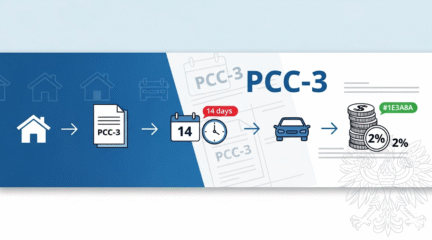
The civil law transactions tax (PCC) at a flat rate of 1% is always paid by the buyer, which in this case is the foreigner acquiring the shares.
The tax base is the current market value of the sold shares. The Tax Office has the right to question too low a price stated in the notarial deed. Understating this price creates a direct risk of a penalty being imposed. The tax authority will then demand payment of the overdue tax along with high default interest. The foreign buyer must independently submit the PCC-3 declaration within just 14 days from the date the contract was concluded.
We have conducted hundreds of such processes and we know that tax offices strictly check the valuations of shares sold to foreigners. We help our clients safely determine the market value of the transaction. We run professional accounting for foreigners and local companies. We offer company accounting services starting from 799 PLN net. This ensures the full security of any settlements with the Polish tax authority.
What PIT tax does the seller pay upon selling shares?
A Polish seller pays personal income tax (PIT) at a fixed rate of 19% on the income earned from selling their shares in a capital company.
Only the income is subject to taxation, not the entire revenue from the transaction. This income is the difference between the sale price and the historical tax-deductible costs. Costs are the real expenses incurred to subscribe for or acquire these shares in the past. The transaction is reported on the PIT-38 form. It must be submitted to the Tax Office by the end of April of the following tax year.
The fact that the buyer of the shares is a foreigner does not affect the tax obligations of the Polish seller. Taxation depends solely on the tax residency of the person selling. These rules are explained in detail on the government portal Biznes.gov.pl.
When should the company be notified about the transfer of shares to a foreigner?
The notification to the company takes place immediately after signing the sale agreement, by submitting to the management board one original copy of the agreement with notarized signatures.
Both the buyer and the seller have the right to notify the board about the completed transaction. Only from this moment is the foreigner officially treated by the company as a full-fledged shareholder. This notification entitles the new investor to vote at shareholders’ meetings. It also allows them to legally collect dividends. A lack of prompt notification paralyzes all corporate rights of the foreigner.
Upon receiving such a notification, the management board of the LLC must immediately update the internal share register. The first name, last name, and address of the new foreign owner are entered there. The share register is a basic internal company document that must be kept perfectly.
How does changing a shareholder to a foreigner affect the company’s bank account?
Commercial banks rigorously verify every change in the ownership structure and strictly require the provision of new identity documentation for the foreign shareholder.
Restrictive anti-money laundering (AML) regulations force financial institutions to identify so-called beneficial owners. If a foreign investor acquires more than 25% of the shares, they automatically become such a beneficiary. The bank will immediately ask the company’s board for a scan of the foreigner’s passport. Bank analysts will also demand detailed declarations about the source of their private wealth.
Ignoring the bank’s summons ends with a quick blockade of corporate accounts. Additionally, the board has a statutory obligation to report the new owner to the Central Register of Beneficial Owners (CRBR). The statutory deadline is exactly 14 days from the moment the changes are made in the KRS. The company faces drastic financial penalties for being late.
How does the procedure of reporting a new shareholder to the KRS work?
The new shareholder must be reported to the National Court Register (KRS) within 7 days from the date of notifying the company about the transfer of share ownership.
This notification is made exclusively electronically, using the state Court Registers Portal (PRS). The statutory obligation to inform the court rests on the incumbent management board of the LLC. The board submits an application to change the data in the register of entrepreneurs. An updated list of shareholders signed by all board members must be attached. A scan of the notarial share purchase agreement is also attached.
From our experience at Progress Holding, judges frequently reject applications due to technical errors in the declarations of foreign shareholders. A lack of an official apostille clause on documents brought from abroad is a very common reason for a return. We offer companies comprehensive support in this complicated area. Full service of a change in the National Court Register starts with us from 1,500 PLN net, which guarantees peace of mind and the correctness of the application.
Summary of costs of selling shares to a foreigner in 2026
Transaction costs include the notary fee for signature certification, the PCC market tax, and a fixed court fee to the KRS for data updates.
Careful budget preparation for this operation is crucial for both parties. Costs are distributed among the buyer, the seller, and the company itself. The table below details and objectively presents all official fees necessary to finalize the process.
| Type of transaction cost | Party bearing the fee | Estimated amount in 2026 |
|---|---|---|
| Notary fee (signature certification) | Buyer or Seller | Around 200 – 500 PLN (depends on the office). |
| Civil law transactions tax (PCC) | Buyer (Foreigner) | Exactly 1% of the market value of the sold shares. |
| Income tax (PIT) | Seller (PL resident) | Exactly 19% of the net income achieved. |
| KRS fee (Court Registers Portal) | Polish LLC | 350 PLN (250 PLN entry + 100 PLN MSiG announcement). |
| Sworn translator service | Buyer (Foreigner) | Around 300 – 600 PLN for translation at the notary. |
The share sale agreement at the notary itself does not exhaust all expenses. One must always remember the costs of legal and accounting services when updating state registers. Delaying the payment of the PCC tax or the court fee will block the registration process in court.
Frequently asked questions
Does a foreigner have to be in Poland to buy shares?
No, a foreigner does not have to personally fly to Poland to finalize such a transaction. They can grant a formal power of attorney to their legal representative on site. However, this power of attorney must be in written form with a notarized signature and must compulsorily bear an apostille clause from the relevant authority in the issuing country.
Can the sale of shares be handled through the S24 system?
Yes, shares can be successfully sold through the government S24 system. This applies exclusively to companies established online whose articles of association have never previously been amended in a traditional notary office. However, this requires both contractors participating in the transaction to possess a trusted profile or a Polish qualified electronic signature.
When does the ownership of shares pass to the foreigner?
The ownership of the held shares passes to the buyer exactly at the moment of signing the share purchase agreement at the notary or on a specific date indicated directly in this agreement. The entry in the KRS system is solely declarative. This means it does not condition the legal fact of acquiring ownership by the foreigner.
Must the board sign the sale agreement?
No, the management board of a limited liability company is not a party to the share sale agreement at all and does not place its signatures on it. The board participates in this passively. It only receives the notification about the change of shareholder and performs a technical update of the registry data in the systems maintained by the commercial court.
Summary
Selling shares in a Polish LLC to a foreigner is an excellent opportunity to acquire foreign capital and expand quickly. The transaction requires strictly maintaining the notarial form, verifying restrictions imposed in the articles of association, and quickly reporting changes to the KRS and CRBR. Proper settlement of PCC and PIT taxes and obtaining MSWiA consent protect the company against serious legal consequences in 2026. Do you need professional advisory support in this process? Contact us at Progress Holding by calling +48 603 232 418 or emailing office@progressholding.pl.